
Introduction
CPR (Cardiopulmonary Resuscitation) is one of the most important emergency skills anyone can learn, but it is also one of the most misunderstood. In a real cardiac arrest, small mistakes can reduce the chances of survival—especially when every second matters.
The good news is that most CPR mistakes are common, predictable, and completely fixable with the right knowledge and training.
In this guide, you’ll learn the most frequent CPR mistakes people make, why they matter, and exactly how to avoid them so you can act with confidence in an emergency.
👉 Quick Action Tip: If you’ve never had hands-on training, consider exploring a CPR certification course after reading this guide. Real practice builds the confidence that reading alone cannot.
What Happens During Cardiac Arrest (Quick Overview)
Cardiac arrest happens when the heart suddenly stops pumping blood effectively. Without blood flow:
- The brain begins to lose oxygen within minutes
- Survival chances drop rapidly each minute without CPR
- Immediate action from bystanders becomes critical
CPR helps keep oxygen circulating until emergency responders or an AED (Automated External Defibrillator) can restart the heart.
The Most Common CPR Mistakes People Make
1. Delaying CPR
What happens: People hesitate before starting CPR.
Why it matters: Every minute without CPR reduces survival chances significantly.
Correct approach: Start chest compressions immediately after confirming the person is unresponsive and not breathing normally.
Common reason for delay: Fear of doing CPR incorrectly.
Key takeaway: Doing something is far better than doing nothing.
2. Not Calling Emergency Services Quickly
What happens: CPR starts but no one calls EMS immediately.
Why it matters: CPR alone does not fix the heart—advanced care is still required.
Correct approach:
- Call emergency services immediately (or instruct someone else to)
- Activate speaker mode so you can begin CPR while staying on the line
Professional Tip: Assign tasks out loud:
“You call emergency services. You get the AED. I’ll start CPR.”
3. Compressing Too Slowly or Too Fast
What happens: Compressions are inconsistent in speed.
Why it matters: Blood flow depends on a steady rhythm.
Correct rate: 100–120 compressions per minute.
Common mistake:
- Too slow → insufficient blood circulation
- Too fast → poor compression quality
Key takeaway: Think “steady rhythm,” not speed rushing.
4. Not Pushing Deep Enough
What happens: Shallow chest compressions.
Why it matters: The heart isn’t fully compressed, reducing blood flow.
Correct depth (adults):
- At least 2 inches (5 cm)
Common cause: Fear of causing injury.
Important note: Rib fractures can happen, but survival is the priority.
5. Not Allowing Full Chest Recoil
What happens: Leaning on the chest between compressions.
Why it matters: Prevents the heart from refilling with blood.
Correct approach:
- Let the chest fully rise after each compression
- Do not keep weight on the chest
Key takeaway: Push down → release fully → repeat.
6. Interrupting Compressions Too Often
What happens: Frequent pauses during CPR.
Why it matters: Blood flow stops every time compressions stop.
Common interruptions:
- Checking pulse too often
- Talking or panicking
- Long AED setup delays
Correct approach:
- Keep interruptions under 10 seconds
- Resume compressions immediately after any pause
7. Incorrect Hand Placement
What happens: Hands placed too high, too low, or off-center.
Why it matters: Reduces effectiveness and may cause injury.
Correct placement:
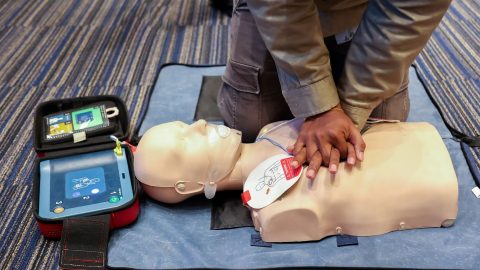
- Center of the chest
- Lower half of the breastbone
Professional Tip: Lock elbows and use upper body weight for control.
8. Giving Too Many or Too Strong Rescue Breaths
What happens: Excess air or forceful breaths.
Why it matters: Can reduce blood return to the heart.
Correct approach:
- Give only enough air to make the chest visibly rise
- Avoid over-ventilation
Key takeaway: “Just enough air” is the goal.
9. Forgetting or Delaying AED Use
What happens: AED is ignored or used too late.
Why it matters: AEDs can restore a normal heart rhythm.
Correct approach:
- Use an AED as soon as it arrives
- Follow voice prompts step-by-step
Myth vs Fact:
- ❌ Myth: “AEDs are only for professionals”
- ✅ Fact: AEDs are designed for public use
10. Stopping CPR Too Early
What happens: CPR is stopped when fatigue sets in or confusion occurs.
Why it matters: Continuous CPR is critical for survival.
Correct approach:
Continue until:
- Emergency responders take over
- The person shows clear signs of life
- You are physically unable to continue
11. Not Recognizing Cardiac Arrest Correctly
What happens: Confusing fainting or breathing patterns with normal activity.
Why it matters: CPR may be delayed unnecessarily.
Correct signs of cardiac arrest:
- Unresponsive
- Not breathing normally (or only gasping)
Professional Tip: “If in doubt, start CPR.”
12. Panic and Loss of Coordination
What happens: Rescuers freeze or act inconsistently.
Why it matters: Delays critical life-saving steps.
Correct approach:
Use a simple sequence:
- Check responsiveness
- Call EMS
- Start compressions
- Use AED when available
Adult vs Child vs Infant CPR Mistakes
| Group | Common Mistake | Correct Approach |
|---|---|---|
| Adult | Too shallow compressions | At least 2 inches deep |
| Child | Using adult force | Adjust depth and gentler pressure |
| Infant | Two-hand technique used incorrectly | Use two fingers or thumb technique |
CPR Quality Checklist
✔ Start CPR immediately
✔ Push hard and fast
✔ Allow full chest recoil
✔ Minimize interruptions
✔ Use AED quickly
✔ Switch rescuers when tired
Why These Mistakes Happen
Most CPR mistakes come from:
- Fear of causing harm
- Lack of hands-on training
- Panic during emergencies
- Misunderstanding proper technique
- Outdated information from videos or assumptions
How Training Helps Prevent These Mistakes
Reading about CPR helps, but practice builds real confidence.
A structured CPR course helps you:
- Practice correct compression depth
- Learn AED usage hands-on
- Reduce hesitation in emergencies
- Understand real-life scenarios
- Build muscle memory under instructor guidance
👉 Learn more about CPR certification and hands-on training options to build real confidence before an emergency happens.
Conclusion
Most CPR mistakes come from hesitation, uncertainty, or lack of training—not lack of ability. The key takeaway is simple: effective CPR is about quick action, steady compressions, and minimizing interruptions.
With proper training, these mistakes become easy to avoid—and your confidence in an emergency increases dramatically.
👉 If you want to be fully prepared, consider enrolling in a CPR certification course or refresher training. Hands-on practice is the best way to ensure you can respond correctly when it matters most.
Frequently Asked Questions
What is the biggest CPR mistake people make?
Delaying CPR or not starting compressions quickly enough is one of the most critical mistakes.
Can you hurt someone during CPR?
Yes, rib injuries can happen, but survival is more important than the risk of injury.
How deep should chest compressions be?
At least 2 inches (5 cm) for adults.
What is the correct CPR rate?
100–120 compressions per minute.
Should I stop CPR if I feel tired?
Only if someone else trained can take over or you are physically unable to continue.
Do I need rescue breaths for CPR?
It depends on training level and situation; hands-only CPR is acceptable for untrained bystanders.
When should I use an AED?
As soon as it becomes available.
What if I do CPR wrong?
Any attempt at CPR is better than none in a cardiac arrest situation.