
Quick Answer: Which CPR Certification Do You Need?
The certification you need is the one your employer, school, or licensing body names. Healthcare roles usually require BLS (Basic Life Support) from the American Heart Association (AHA). Most other jobs accept CPR/AED from the AHA or the American Red Cross. Always pick a course with in-person hands-on practice.
Key Takeaway: Acceptance matters more than brand. A card your employer rejects is the most expensive option, whatever it cost.
Which CPR Certification Do You Need? A Decision Guide
Start with the requirement, not the course. Ask who requires the card, what name they use for it, and whether they specify a provider or a hands-on component. Your answers point to one of three common paths: BLS, CPR/AED with First Aid, or CPR/AED alone.
Work through these steps in order and stop at the first match:
- Does your job or program say “BLS,” “BLS Provider,” or “healthcare provider CPR”? Take a BLS course. Check whether the employer names AHA specifically.
- Does the requirement say “First Aid and CPR”? Take a combined First Aid/CPR/AED course.
- Does it say only “CPR” or “CPR/AED”? A CPR/AED course for lay rescuers is usually the match. Confirm which providers are accepted.
- Is there no requirement, only a wish to be prepared? Any hands-on CPR/AED course from an established provider serves you well.
- Not sure? Send your employer or school the question using the template further down this page.
Instructor Insight: The most common pattern in class is a learner holding the wrong card for the right reason. A nursing student with a lay-rescuer card, for example, took a perfectly good course, just not the one the program listed. Reading the exact wording in the job posting or student handbook prevents most of these cases.
Types of CPR Certification
CPR certification comes in three main levels. CPR/AED teaches lay rescuers to respond to cardiac arrest. First Aid adds injury and illness response. BLS (Basic Life Support) is the healthcare-provider level, with team-based skills and higher expectations. Advanced courses such as ACLS and PALS build on BLS.
CPR/AED for lay rescuers
CPR stands for cardiopulmonary resuscitation. An AED is an automated external defibrillator, a device that analyzes the heart rhythm and can deliver a shock. Lay-rescuer courses cover adult, child, and infant CPR, AED use, and choking relief. The AHA calls its version Heartsaver; the Red Cross calls its version CPR/AED. Typical learners are teachers, coaches, childcare providers, office staff, and parents.
First Aid with CPR/AED
Combined courses add bleeding control, burns, allergic reactions, and other common emergencies. Many workplaces and childcare programs ask for this version because it covers more situations. Employers who rely on a workplace safety plan often prefer it.
BLS (Basic Life Support)
BLS is built for people who respond as part of a healthcare team: nurses, EMTs, nursing and medical students, dental staff, and similar roles. It adds two-rescuer technique, bag-mask ventilation, and team coordination. Nursing students and others entering clinical programs are often asked for it before the first placement.
Advanced courses (ACLS and PALS)
Advanced Cardiovascular Life Support (ACLS) and Pediatric Advanced Life Support (PALS) are for clinicians managing complex emergencies. Most programs expect a current BLS card first. Learn more in our ACLS and PALS guides.
| Level | Who it fits | Skills it adds | Common requirement |
| CPR/AED | Teachers, coaches, office staff, parents | Adult, child, infant CPR; AED; choking | Many workplaces and schools |
| First Aid + CPR/AED | Childcare, workplace safety teams | Bleeding, burns, allergic reactions | Childcare, some workplaces |
| BLS | Nurses, EMTs, clinical students | Two-rescuer CPR, bag-mask, team roles | Hospitals, clinical programs |
| ACLS / PALS | Clinicians managing complex arrest | Medications, rhythms, advanced care | Many hospital units |
AHA vs. Red Cross: What Is the Difference?
The American Heart Association (AHA) and the American Red Cross both teach CPR based on international resuscitation science, and both are widely recognized. The difference is mostly acceptance: hospitals and clinical programs often name AHA, while workplaces, schools, and community roles often accept either.
| Factor | AHA | American Red Cross |
| Typical setting | Hospitals, clinical programs, EMS | Workplaces, schools, community groups |
| Healthcare course name | BLS Provider | Basic Life Support (BLS) |
| Lay-rescuer course name | Heartsaver | Adult and Pediatric First Aid/CPR/AED |
| Formats | In-person, blended | In-person, blended |
| Card validity | Commonly two years | Commonly two years |
| Accepted by every employer? | No | No |
Validity and acceptance vary by course and employer. Confirm on the course page and with the requirement-setter.
What employers and programs commonly expect
Many hospitals and clinical programs specify AHA BLS in their credentialing policies. Many non-clinical workplaces and schools accept either AHA or Red Cross. A smaller number name another recognized provider, so check the exact wording.
Myth vs. Fact Myth: One of them is “more valid” than the other. Fact: Both follow recognized resuscitation science. What differs is which one a given employer or program has chosen to accept. That is a policy decision, not a quality ranking.
Common Mistake: Assuming that a card accepted at your last job will carry over. Employer policies differ, and a card that satisfied one workplace can be rejected by the next.
We will cover this further in our guide to AHA vs. Red Cross CPR certification.
Online, Blended, or In-Person CPR Training?
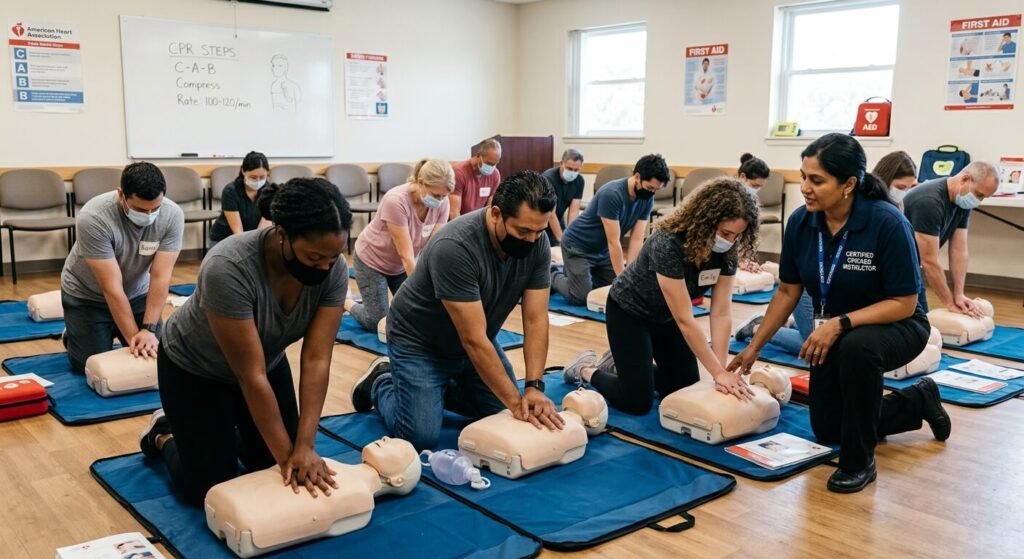
CPR training comes in three formats. In-person courses are taught fully in a classroom. Blended courses pair online coursework with an in-person skills session. Online-only courses have no hands-on component. Employers and programs that require certification usually require hands-on practice with an instructor.
| Format | How it works | Hands-on skills check? | Typical acceptance |
| In-person | Full class with an instructor and manikins | Yes | Broadly accepted when from a recognized provider |
| Blended | Online lessons first, then a short in-person skills session | Yes | Broadly accepted when from a recognized provider |
| Online-only | Videos and quizzes, no in-person session | No | Often not accepted for workplace or clinical requirements |
Why online-only often falls short
CPR is a physical skill. Compression depth, hand position, and rhythm are hard to judge without feedback from an instructor or a feedback manikin. The Red Cross states that online-only CPR without an in-person skills session does not meet workplace certification needs, and many employers apply the same standard.
How blended learning works
You finish the online portion at your own pace, then attend a shorter session where an instructor watches you perform the skills. Blended learners typically receive the same certification as those who take the fully in-person course. Healthcare learners often use the AHA’s HeartCode blended option for BLS.
Quick Tip: If the course description does not mention a hands-on skills session, ask before you pay.
Checklist: before you book any course
- The course name matches your requirement (BLS, CPR/AED, First Aid/CPR/AED).
- The provider is one your employer or school accepts.
- The course includes an in-person skills session with an instructor.
- The card is issued by the named provider, not only by the training company.
- You know the validity period shown on the card.
How Long Does CPR Certification Take, and What Does It Cost?
Course length depends on level and format: a lay-rescuer CPR/AED course is typically shorter than BLS, and blended courses split time between online study and a short skills session. Prices vary by provider, location, and format, so compare complete costs, including card fees and materials.
What to compare:
- Total price, including any separate skills-session fee or card fee
- Total time, meaning both the online portion and the in-person session
- Class size and manikin access, since more practice time means better skill retention
- Rescheduling policy, in case a shift or class changes
Instructor Insight: Learners often compare the advertised online price against a full in-person price. Many online-only offers leave out the hands-on session that the employer requires, so the cheaper option can cost more once you retake the right course.
We do not list prices here because they change. See current class schedules and pricing.
How Long Is CPR Certification Valid? Renewal Explained
AHA and Red Cross CPR cards are commonly valid for two years, but the date printed on your card is the one that counts. Renewal means retaking a course, often a shorter one, before the card expires. Some employers require renewal earlier.
Certification lasts for a limited period because skills fade without practice. Renewal courses refresh technique and cover updates in guidance.
A simple renewal timeline:
- Day of class: Note the expiration date on your card.
- Several months before expiration: Set a calendar reminder.
- One to two months before: Book a renewal class, so a full-length course is not your only option.
- If it lapses: Ask the provider whether a shorter renewal is still available or whether you must take the full course. Policies differ.
Common Mistake: Waiting until the week of expiration. A cancelled class can leave a gap in compliance, which matters for jobs that require continuous certification.
Best CPR Certification by Role
Match the course to your role. Healthcare workers and students typically need BLS. Teachers, childcare providers, and coaches typically need CPR/AED with First Aid. Parents and community members can choose any hands-on CPR/AED course. Always confirm the exact wording of your own requirement.
| Role | Course that usually fits | Check this first |
| Nurse or nursing student | BLS | Whether AHA is named; the clinical program’s policy |
| EMT or paramedic student | BLS, plus program-specific courses | Program and agency requirements |
| Medical assistant or dental staff | BLS | Employer or licensing rules |
| Teacher or school staff | CPR/AED, often with First Aid | District policy |
| Childcare provider | First Aid with CPR/AED, often infant and child focus | State or local licensing rules |
| Coach or recreation staff | CPR/AED, often with First Aid | League or organization requirements |
| Office or workplace team | CPR/AED with First Aid | Employer safety plan |
| Parent or caregiver | CPR/AED with infant and child content | Nothing required; choose hands-on |
Employer Perspective: Safety managers commonly want proof that the skills were practiced with an instructor, along with a card that names a recognized provider. Bringing the course title, provider, and skills-session details to HR can speed approval.
For workplace teams, see group training for workplaces, and for related workplace obligations, our OSHA workplace training overview.
What Has Changed in the Latest Guidelines?
The AHA updates its CPR and emergency cardiovascular care guidelines roughly every five years. The most recent update unifies the Chain of Survival, changes the choking sequence for conscious adults and children, adds a public-access opioid overdose algorithm, and affirms that children 12 and older can learn CPR and AED use.
- One Chain of Survival. A single chain now applies to cardiac arrest across ages and settings.
- Choking relief. For a conscious adult or child with severe choking, rescuers alternate five back blows with five abdominal thrusts until the object clears or the person becomes unresponsive.
- Opioid overdose. A public-access response algorithm emphasizes naloxone and recognizing signs such as slowed or absent breathing.
- Teen training. Evidence supports CPR and AED training for children 12 and older.
Important Note: Guidelines are updated on a cycle, and courses take time to follow. If you are choosing between providers or class dates, ask which version of the guidelines the class teaches.
Common Mistakes When Choosing a CPR Course
The most frequent mistakes are choosing by price alone, assuming online-only cards are accepted, and booking the wrong level. Each is avoidable by confirming requirements in writing before registering.
- Choosing online-only because it is quick. Without hands-on practice, many employers will not accept the card.
- Booking the wrong level. CPR/AED is not BLS, and First Aid is not CPR.
- Assuming any provider works. Check whether your employer names one.
- Skipping the renewal date. Expired cards can leave a compliance gap.
- Not asking for the requirement in writing. A written answer protects you if questions come up later.
Myth vs. Fact
Myth: Any CPR certificate works for any job.
Fact: Requirements are set by employers, schools, and licensing bodies, and they differ.
How to Confirm Employer Acceptance
Confirm acceptance by asking your employer, school, or licensing body three things: which course name is required, which providers are accepted, and whether hands-on practice is required. Get the answer in writing, then book the matching course.
Sample message you can adapt:
Hello, I am planning to complete my CPR certification. Could you confirm (1) the exact course name you require, (2) whether you accept both AHA and American Red Cross cards, and (3) whether a blended course with an in-person skills session meets the requirement? Thank you.
Group and Corporate Training Options
Group training lets a workplace certify several employees at once, on-site or at a training center. It suits organizations with a safety program, childcare centers, schools, and clinics that want consistent training and a single record for compliance.
Reasons teams choose group training:
- A consistent course and provider across the team
- Scheduling that fits shifts
- Easier tracking of renewal dates
Workplace notes (verify before publication): OSHA’s first aid standard (29 CFR 1910.151) addresses having someone adequately trained in first aid when no clinic or hospital is nearby. OSHA does not certify courses or name a provider. Check OSHA’s current interpretations for any hands-on training expectations. Local and state rules may add requirements.
If you are planning for a team, schedule group training or contact an instructor to talk through your needs.
Frequently Asked Questions
Beginner Questions
What are the types of CPR certification? The main types are CPR/AED for lay rescuers, First Aid combined with CPR/AED, and BLS for healthcare providers. ACLS and PALS are advanced courses for clinicians. Choose by the name your employer or school requires.
What is the difference between CPR and BLS? CPR/AED is designed for the general public. BLS is for healthcare providers and adds team-based skills, such as two-rescuer CPR and bag-mask ventilation. Healthcare programs usually require BLS.
Do I need first aid training as well? Only if your requirement says so. Childcare, many workplaces, and some schools ask for First Aid together with CPR/AED. If you want broader preparedness, the combined course is a sensible choice.
Certification Questions
Is online CPR certification valid? Online-only courses with no hands-on session are often not accepted for workplace or clinical requirements. Blended courses that include an in-person skills session are widely accepted when from a recognized provider. Confirm with your employer first.
AHA or Red Cross: which is better? Neither is universally better. Both follow recognized resuscitation science. AHA is often named by hospitals and clinical programs, while many workplaces and schools accept either.
How long does CPR certification last? AHA and Red Cross CPR cards are commonly valid for two years. The expiration date on your card is the one that applies, and some employers require earlier renewal.
Can I renew CPR certification online? Often a renewal can be partly online, but most recognized providers still require an in-person skills session. Check the renewal course description.
Practical Questions
How long does a CPR class take? It depends on the level and format. Lay-rescuer courses are shorter than BLS, and blended formats divide time between online study and a skills session. The course listing shows the total time.
Do I need to be physically fit to take CPR? No. Instructors adapt practice to your ability, and compression technique relies more on body position than strength. Tell your instructor about any limits when you register.
Is blended learning as good as in-person? Blended learners typically receive the same certification as fully in-person learners, since both include hands-on assessment with an instructor.
Workplace Questions
Does my employer accept Red Cross CPR? Many non-clinical employers do, but policies differ. Ask which providers they accept and whether they require a particular course name.
What does OSHA require for CPR training? OSHA’s first aid standard addresses having trained responders where no clinic or hospital is nearby, and OSHA does not certify courses. Specific expectations depend on your workplace, so confirm current OSHA interpretations and local rules.
Can our workplace train a group at once? Yes. Group classes can be arranged for teams, often at your site. Ask about schedules, class size, and how records are kept.
Local Questions
Where can I take a CPR class near me? Look for a class from a recognized provider that includes a hands-on session. View upcoming classes or contact our team for options in your area.
Do state boards accept online CPR? Rules vary by state and profession, and many boards defer to employer policy. Check with your board or employer directly rather than relying on a general answer.
Key Takeaways
- Choose the certification your employer, school, or licensing body names.
- Healthcare roles typically need BLS, often from AHA. Many other roles accept AHA or Red Cross CPR/AED.
- Pick a course with hands-on practice. Online-only is often not accepted.
- Cards are commonly valid for two years, but the date on your card is what counts.
- Ask for requirements in writing before you pay.
- Guidelines change on a cycle, so confirm what your class teaches.
Ready to choose? Explore our CPR, First Aid, and BLS courses and pick a class with a hands-on skills session. Have a question about which card your employer needs? Contact an instructor and we will help you check before you register.