
A patient stands up from the exam table, goes pale, and slumps. The physician is down the hall. You are the closest person with training. That moment is why CPR sits on nearly every medical assistant’s to-do list, and why the details of which certification you hold matter more than most people expect.
This guide explains what medical assistants typically need, how CPR differs from BLS, what employers tend to accept, and how a clinic team actually responds when someone collapses.
Why CPR Matters for Medical Assistants
Short answer: Medical assistants work where patients are already sick, anxious, or having procedures. That makes them frequent first responders to collapse, choking, severe allergic reactions, and breathing emergencies until a physician, nurse, or EMS arrives.
Cardiac arrest means the heart stops pumping effectively. Cardiopulmonary resuscitation (CPR) keeps blood moving to the brain and heart, and an automated external defibrillator (AED) can restart a shockable rhythm. Neither works alone. Together with calling 911 and emergency medical services (EMS), they form the early links in the Chain of Survival.
Where MAs fit in the Chain of Survival
The Chain of Survival describes the actions that give someone the best chance of surviving cardiac arrest. The American Heart Association (AHA) now uses a single six-link version across adult, pediatric, and in-hospital settings. In a clinic, an MA is often the person who recognizes the problem, activates the emergency response, starts compressions, and brings the AED. Hospital care and recovery come later, after EMS takes over.
Instructor Insight: Students often assume cardiac arrest only happens in hospitals. In practice, a clinic may be the first place a person’s heart stops, and the first minutes belong to whoever is in the room.
What changed in recent AHA guidance for MAs
The AHA updated its CPR and Emergency Cardiovascular Care guidelines in 2025. Three changes are worth knowing:
- Unified chain of survival. One framework now applies across ages and settings.
- Naloxone in the response. When naloxone is available, training and workplace emergency plans should now cover how and when to give it.
- Patients with obesity. Standard CPR techniques apply, with no modified compressions or ventilation.
Course content varies by provider and version, so ask your training center which guideline edition your class follows.
Do Medical Assistants Need CPR or BLS?
Short answer: In many settings, yes. Medical assistants are commonly asked to hold CPR or BLS certification, but the requirement usually comes from an employer, school program, or credentialing body, not from one universal rule. Check the source that applies to you before paying for a course.
The requirement can come from several places:
| Source | What to expect | What to do |
| Employer | Many healthcare employers specify BLS and sometimes a particular provider | Ask HR or the practice manager for the exact course name |
| MA program | Programs often build CPR or BLS into training or clinical placement | Check the program handbook or ask your coordinator |
| Credentialing body | Policies vary by organization (for example AAMA, NHA, AMT) | Review the current candidate handbook [VERIFY] |
| State or facility rules | Scope of practice and facility policy differ by location | Verify locally; do not assume |
Important Note: This article is educational. It cannot tell you what your employer, state, or credentialing body requires. Treat their written policy as the final word.
Questions to ask before you enroll
- Which course name do you accept (for example, BLS Provider or CPR/AED for healthcare)?
- Do you require a particular organization, such as the AHA or the American Red Cross?
- Is a hands-on skills session required?
- Are blended courses accepted?
- How soon after hire or enrollment must I be certified?
- Will you reimburse the cost or pay for group training?
Visual Suggestion: Printable “Employer Verification Checklist” (PDF) based on this list.
Employer Perspective: Clinic managers commonly care about three things: the right course level, a verifiable card, and a current expiration date. A card that is valid but the wrong type is the most frequent surprise.
CPR vs. BLS vs. First Aid: What’s the Difference?
Short answer: CPR is a skill. Basic Life Support (BLS) is a healthcare-provider course that teaches CPR plus team-based response, AED use, and advanced-level technique for professionals. First aid covers injuries and illness more broadly, such as bleeding, burns, and seizures.
| Feature | Layperson CPR/AED | BLS for healthcare providers | First Aid |
| Main audience | General public | Clinicians and clinical support staff | General public and workplaces |
| Core focus | Compressions, AED | Team CPR, AED, bag-mask ventilation, all age groups | Injury and illness care |
| Team response | Limited | Emphasized | Not the focus |
| Typical fit for MAs | Sometimes accepted | Often the expected choice | Useful add-on |
When a table is read aloud: each row compares one feature across the three course types, in the order listed in the header.
Myth vs. Fact Myth: Any CPR card satisfies a healthcare job requirement. Fact: Many healthcare employers ask specifically for a BLS-level course. Confirm before you book.
Which Certification Should You Take?
Short answer: Match the course to your situation. New MA students and new hires usually start with BLS. Current MAs renew before expiration. Those taking on more responsibility may add advanced courses.
- Student or new hire: Start with BLS unless your program or employer says otherwise.
- Already certified: Renew before your card expires.
- Employer says “CPR”: Ask whether they mean layperson CPR or BLS.
- Want to advance: Consider Advanced Cardiovascular Life Support (ACLS), Pediatric Advanced Life Support (PALS), or instructor training later.
Not sure? Explore BLS Certification or contact an instructor and describe your situation.
What You’ll Learn in a BLS or CPR Course for MAs
Short answer: A healthcare-level course teaches high-quality chest compressions, breaths with a barrier device or bag-mask, AED use, choking relief, and how to work as part of a resuscitation team, across adult, child, and infant patients.
Common skills include:
- Recognizing cardiac arrest and calling for help
- Chest compressions at the recommended rate and depth with full recoil
- Ventilation with a pocket mask or bag-valve mask
- Using an AED
- Relieving choking
- Team roles and clear communication
- Naloxone use, depending on current course content [VERIFY]
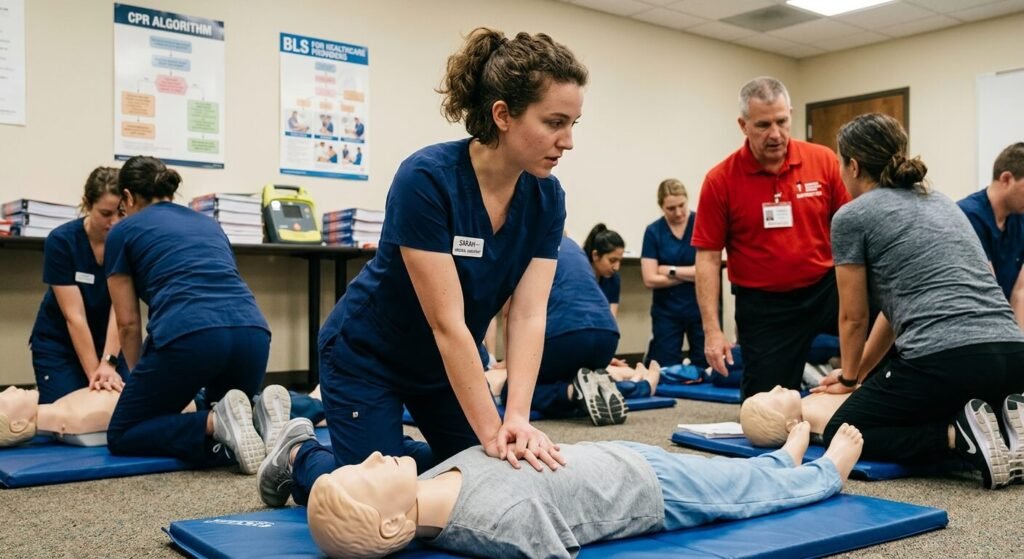
Quick Tip: Compressions should be fast, deep, and interrupted as little as possible. Your instructor will give the exact rate and depth for your course version. Feedback manikins help you feel the difference.
Classroom Observation: Learners often compress too shallowly because they fear hurting the patient. Instructors would rather see firm compressions than timid ones. Rib discomfort is a known possibility in real resuscitation, and the priority is circulation.
To learn what an AED actually does, see AED training.
Emergency Scenarios Medical Assistants Actually Face
Short answer: The emergencies MAs most often meet are fainting, collapse, severe allergic reactions, choking, and overdose. The key skill is deciding quickly whether the person is breathing normally and responsive, then calling for help and starting care.
These are teaching examples, not medical advice.
Scenario 1: Collapse in the waiting room
A patient slumps in a chair. You tap their shoulder and call their name. No response, and breathing is absent or only gasping.
- Shout for help and have someone call 911 and get the AED.
- Lower the patient to a firm, flat surface.
- Start chest compressions.
- Turn on the AED when it arrives and follow its prompts.
- Continue until EMS or a clinician takes over.
Scenario 2: Fainting or cardiac arrest?
Fainting usually brings a quick return of responsiveness and normal breathing. Cardiac arrest does not. If the person is unresponsive and not breathing normally, treat it as cardiac arrest.
Common Mistake: Waiting to “see if they come around” when breathing is abnormal. Gasping is not normal breathing.
Scenario 3: Allergic reaction after an injection
Symptoms such as hives, swelling, wheezing, or trouble breathing can signal anaphylaxis. Alert the clinician immediately and follow your clinic’s emergency protocol, which may include epinephrine under authorized orders. Scope of practice varies, so know what your role permits. [VERIFY by state and employer]
Scenario 4: Suspected opioid overdose
Check responsiveness and breathing, call 911, and follow your workplace protocol for naloxone if it is available and you are trained. Begin CPR if there is no normal breathing and no pulse.
Who Does What? A Clinic Team Response Checklist
Short answer: Assign roles before an emergency. A prepared team assigns someone to call 911, someone to fetch the AED and emergency supplies, someone to perform compressions, and someone to document and meet EMS.
| Role | Task |
| Responder | Check responsiveness, start compressions |
| Caller | Call 911 and give the clinic address |
| AED runner | Bring the AED, emergency cart, and oxygen if available |
| Recorder | Note times and actions |
| Door greeter | Meet EMS and clear a path |
Professional Tip: Practice the layout of your own clinic. Know where the AED is before you need it.
Online, Blended, or In-Person? What Employers Accept
Short answer: Acceptance varies. Healthcare providers typically need a hands-on skills session, and many employers do not accept courses that are completely online. Blended courses pair online learning with an in-person skills check. Confirm the format with your employer before you book.
| Format | How it works | Common acceptance |
| In-person | All instruction and skills in a classroom | Widely accepted |
| Blended | Online lessons plus hands-on skills session | Often accepted [VERIFY] |
| Online only | No hands-on practice | Frequently not accepted for healthcare jobs |
Myth vs. Fact Myth: An online certificate is always valid for work. Fact: Healthcare employers often require an in-person skills check. Ask first.
How Much Does It Cost and How Long Does It Take?
Short answer: Cost and duration depend on the provider, course type, and format. Blended and renewal courses are often shorter than first-time courses. [INSERT current pricing and class length from your course pages.]
Factors that change the price:
- First-time course vs. renewal
- In-person vs. blended
- Individual vs. group booking
- Included materials and certification card
View class schedules and pricing
How Long Does Certification Last, and When to Renew
Short answer: BLS and CPR certifications commonly last two years, although this varies by organization and course. Renew before your card expires to avoid a gap in coverage. Your card lists the exact expiration. [VERIFY by provider]
Practical Example: If your card expires at the end of June, schedule renewal in the spring. Classes fill up, and some employers do not allow you to work clinical shifts with an expired card.
Common Mistakes (Learners and Employers)
- Taking layperson CPR when BLS was required
- Choosing an online-only course without checking acceptance
- Letting a card lapse
- Not knowing where the AED is
- Skipping team practice
- Assuming one organization’s card transfers everywhere
Myths vs. Facts
| Myth | Fact |
| “I’m not a nurse, so I won’t need to use CPR.” | MAs are often among the first to respond in a clinic. |
| “I’ll hurt the patient.” | Firm compressions are expected; hesitation costs time. |
| “The AED will shock anyone.” | AEDs analyze rhythm and shock only when appropriate. |
| “CPR is the same everywhere.” | Core principles are shared, but course details vary by organization. |
Next Steps After BLS
Once BLS is current, many MAs add First Aid training, learn about bloodborne pathogens, or explore ACLS and PALS for broader healthcare careers. Experienced MAs who enjoy teaching may look into instructor courses.
Frequently Asked Questions
Beginner Questions
What is CPR, and why do medical assistants learn it? CPR (cardiopulmonary resuscitation) is an emergency technique that keeps blood flowing when the heart stops. MAs learn it because they work with patients who may suddenly become seriously ill and are often the first to respond.
Is CPR the same as BLS? No. CPR is one skill. BLS is a healthcare-provider course that teaches CPR along with AED use, team response, and ventilation techniques.
Certification Questions
Do medical assistants need CPR or BLS certification? Many do, but the requirement comes from an employer, school, or credentialing body, not a single universal rule. Check their written policy.
How long does CPR or BLS certification last? Typically two years, but it varies by organization. Check the expiration date on your card.
How do I renew my certification? Take a renewal or recertification course before your card expires. Some providers offer shorter renewal classes.
Is online-only CPR accepted for medical assistants? Often not. Many healthcare employers require a hands-on skills session. Confirm before booking.
Which is better for MAs, AHA or Red Cross? Both are recognized training organizations. Some employers specify one, so ask which they accept.
Practical Questions
What does a medical assistant do during cardiac arrest? Recognize the emergency, call for help, start compressions, and use an AED until EMS or a clinician takes over, following clinic protocol.
What if I’m afraid of hurting someone? Firm compressions are part of effective CPR. Training builds confidence, and hesitating costs more than imperfect technique.
Do MAs learn to use an AED? Yes. AED use is a standard part of healthcare-level CPR and BLS courses.
Workplace Questions
Will my employer pay for certification? That depends on the employer. Ask HR about reimbursement or group training.
Can my clinic book group training? Often yes. See group and corporate training.
What should a clinic’s emergency plan include? Assigned roles, AED location, emergency contacts, protocols for common emergencies, and regular practice.
Get help choosing a course: Compare certifications or contact an instructor.
Key Takeaways
- Most MAs need a healthcare-level course, usually BLS, but the requirement comes from your employer, program, or credentialing body.
- CPR is a skill; BLS adds team response, AED use, and healthcare-specific technique.
- Hands-on practice matters, and online-only courses are frequently not accepted.
- Cards commonly last two years, so renew early.
- Know your clinic’s roles and your AED location before an emergency.
Ready to get certified or renew? View BLS and CPR classes for healthcare providers. Prefer to talk it through? Contact an instructor or schedule group training for your clinic.