
Sedation has changed what’s possible in dentistry. Patients who once avoided the chair out of fear or medical complexity can now get the care they need comfortably. But sedation also changes the risk profile of a routine procedure. A patient who is breathing calmly under moderate sedation can, within minutes, need a level of emergency response that basic CPR training was never designed to provide.
That’s where ACLS comes in.
This guide walks through what ACLS actually covers, when it’s required for sedation dentistry, how it fits alongside BLS and PALS, and what your team needs to know about the guideline updates reshaping this space right now. Whether you’re a dentist confirming your own compliance, an office manager building a training plan, or a student trying to understand why this certification keeps coming up, you’re in the right place.
What Is ACLS, and Why Does It Matter in Dentistry?
ACLS (Advanced Cardiovascular Life Support) is an emergency-response certification that trains healthcare providers to recognize and treat cardiac arrest, life-threatening arrhythmias, and related emergencies using a structured, team-based approach. In dentistry, it matters because sedation and general anesthesia can produce exactly these kinds of emergencies — and ACLS is what prepares a dental team to manage them, not just call for help and wait.
Basic Life Support (BLS) teaches high-quality chest compressions, rescue breathing, and AED use. It’s foundational, and every member of a dental team benefits from it. ACLS builds on top of that foundation. It adds the pharmacology, rhythm recognition, and decision-making skills needed when compressions and a shock aren’t enough on their own — situations that are far more likely to arise when a patient is sedated than when they’re simply sitting for a filling.
Instructor Perspective: In BLS classes, dental professionals often assume their sedation training already “covers” cardiac emergencies. It doesn’t. Sedation courses teach how to monitor a patient and manage routine sedation-related events like mild oxygen desaturation. ACLS teaches what to do when those routine events escalate into something the sedation course didn’t prepare you for.
ACLS vs. BLS: What’s the Difference?
|
BLS |
ACLS |
|
|
Core skill |
Chest compressions, rescue breathing, AED use |
Advanced airway support, rhythm interpretation, emergency medications |
|
Who typically needs it |
All clinical dental staff |
Dentists and providers performing moderate sedation, deep sedation, or general anesthesia |
|
Designed for |
The first minutes before advanced help arrives |
Managing the emergency itself, including drug administration and team leadership |
|
Renewal cycle |
Every 2 years |
Every 2 years |
Quick Tip: Think of BLS as “keep the patient alive until more help arrives” and ACLS as “become the more help.”
Where PALS Fits In for Pediatric Sedation
If your practice sedates children, ACLS alone doesn’t tell the full story. Pediatric Advanced Life Support (PALS) is the pediatric counterpart to ACLS, built around the physiological differences between children and adults during a cardiac or respiratory emergency. Many dentists who treat both adult and pediatric sedation patients hold both certifications, and some state boards require PALS specifically for pediatric sedation permits.
Key Takeaway: If your patient population includes children under sedation, don’t assume ACLS alone satisfies your requirement — check whether PALS is expected for that portion of your practice.
Is ACLS Required for Sedation Dentistry?
Whether ACLS is required depends on the level of sedation you provide and the rules of your state dental board — there is no single national rule that applies to every dentist. Generally, minimal sedation (anxiolysis) carries the lightest requirements, often just BLS. Moderate sedation, deep sedation, and general anesthesia typically require ACLS, and sometimes PALS as well when pediatric patients are involved.
This is one of the most misunderstood points in dental sedation compliance. Dentists sometimes assume that because they’re “just” doing oral conscious sedation, their existing BLS certification is enough. Other times, dentists who hold an ACLS card assume it satisfies every state’s requirement without checking whether their specific permit level demands something more, like a certain number of live patient case hours or a board-approved course.
How Requirements Vary by Sedation Level
|
Sedation Level |
What It Means |
Typical Certification Expectation* |
|
Minimal (anxiolysis) |
Patient is relaxed but fully responsive |
BLS |
|
Moderate sedation |
Patient is drowsy but can respond purposefully to verbal or light physical stimulation |
BLS, often ACLS |
|
Deep sedation |
Patient cannot be easily aroused but responds to repeated or painful stimulation |
ACLS, sometimes PALS for pediatric cases |
|
General anesthesia |
Patient is unresponsive, even to painful stimulation |
ACLS, sometimes PALS, plus additional advanced training |
*This table reflects general patterns seen across professional guidance. It is not a substitute for your state dental board’s specific rule, which is the only source that determines your actual legal requirement.
Important Note: Some states also require a set number of live patient case experiences, a minimum number of classroom training hours, or a separate sedation permit application — none of which ACLS certification alone satisfies. ACLS is typically one requirement among several, not the entire pathway.
How Requirements Vary by State
State dental boards set their own rules for sedation permits, and those rules don’t move in sync with each other or with national guidelines. Some boards specify ACLS by name. Others accept “board-approved airway management training” as an alternative. Some layer on continuing education requirements every renewal cycle; others don’t.
Common Mistake: Assuming that because a colleague in another state got their sedation permit without ACLS, the same applies to you. State-by-state variation here is real and significant enough that it shouldn’t be guessed at.
What to do instead: Check your own state dental board’s current sedation rule directly, and confirm the specific permit level you’re applying for or renewing, since minimal, moderate, and deep sedation permits are frequently governed by different sections of the same regulation.
Disclaimer: This section provides general educational information about how sedation-level and certification requirements commonly work. It is not legal or regulatory advice. Always verify your specific requirement with your state dental board before making certification or scheduling decisions.
The Clinical Rationale: Why Sedation Increases Emergency Risk
Sedation and general anesthesia depress the central nervous system, which can slow breathing, relax the airway, and affect heart rhythm — the same physiological changes that make emergencies more likely and more serious than they would be in an unsedated patient. Understanding this rationale is what turns ACLS from “a box to check” into a skill set you actually want your team to have.
Respiratory Depression and Airway Compromise
Sedative medications reduce the drive to breathe and relax the muscles that keep the airway open. In a dental chair, with the patient reclined and instruments in the mouth, this creates a scenario where oxygen levels can drop before anyone notices — unless the team is actively watching for it. Left unmanaged, respiratory depression can progress to full airway obstruction, and from there to cardiac arrest.
Cardiac Arrhythmia and Arrest Risk
Low oxygen levels stress the heart. So do certain sedative and anesthetic medications, particularly in patients with underlying cardiac conditions that weren’t obvious during a routine health history. The result can be an arrhythmia — an abnormal heart rhythm — that a BLS-trained provider can recognize as “something is wrong” but isn’t trained to diagnose or treat. ACLS training fills that exact gap: interpreting the rhythm, choosing the right medication or intervention, and directing a coordinated response.
A Realistic Scenario
A patient under moderate sedation for a lengthy restorative procedure begins to breathe more shallowly. The monitor’s oxygen saturation reading drops from 98% to 91% over several minutes — a gradual change easy to miss if no one is watching the numbers closely. Without intervention, the drop continues. The patient’s heart rate becomes irregular.
A BLS-only trained team recognizes something is wrong and can support airway and breathing, but the moment the situation involves an arrhythmia requiring medication, they’re waiting for EMS to arrive and take over. An ACLS-trained dentist, by contrast, recognizes the rhythm, knows which medication protocol applies, and manages the emergency directly while EMS is still en route — often the difference between a frightening close call and a genuine crisis.
Key Takeaway: ACLS doesn’t just prepare you for the worst-case scenario. It prepares you to catch and correct problems before they become the worst-case scenario.
What’s New: Recent Guideline Updates Dentists Should Know
Both the certification standards behind ACLS and the dental-specific sedation guidelines that reference it have gone through their most significant updates in years — which means dentists relying on older training materials or older compliance summaries may be working from outdated information. Staying current here isn’t just a formality; the changes affect equipment expectations, documentation practices, and training emphasis.
Updated Resuscitation Science Behind ACLS
The American Heart Association periodically reviews and updates the science behind its CPR and Emergency Cardiovascular Care guidelines, which form the foundation of ACLS courses. These reviews incorporate new evidence and can shift recommendations for adult and pediatric life support. Training centers work through a transition period after each update, during which courses and materials are brought in line with the new standard. If your ACLS card was issued before your training provider completed that transition, it’s worth confirming your certification reflects current course materials at your next renewal.
Updated ADA Sedation and Anesthesia Guidelines
The American Dental Association periodically revises its Guidelines for the Use of Sedation and General Anesthesia by Dentists — and its companion guidelines for teaching sedation to dental students — to reflect current evidence and align with national anesthesia standards. Recent revisions have placed new emphasis on things like supplemental oxygen use during moderate sedation and above, more detailed patient assessment and dosing documentation, and — importantly for this article — stronger expectations around emergency preparedness, including regular training drills and documented emergency protocols.
Did You Know? These ADA guidelines don’t override your state dental board’s rules, but state boards often look to them when writing or updating their own regulations. A guideline change today can become a state requirement change within the next year or two.
Professional Tip: Rather than treating a guideline update as a one-time read, build a habit of checking your state board and the ADA’s published guidelines annually, ideally around your certification renewal date, so updates never catch your practice off guard.
ACLS Training and the Dental Team’s Emergency Response
A dental sedation emergency is rarely a one-person event — it’s a team response, and ACLS training changes what that team is capable of doing in the critical minutes before or alongside EMS arrival. Knowing who does what, and having that decided before an emergency happens, is one of the most overlooked parts of sedation safety.
What an ACLS-Trained Response Looks Like
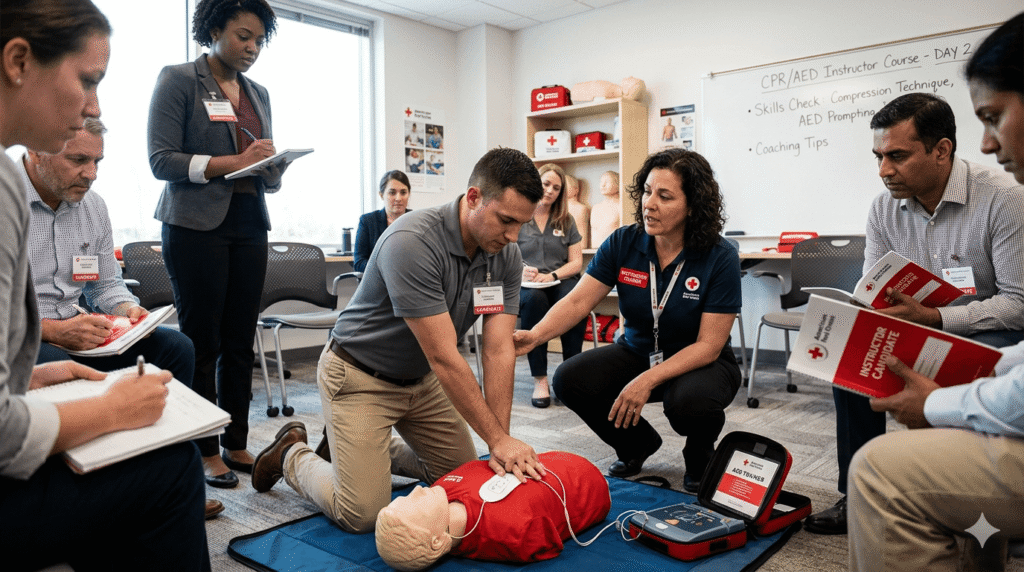
In an emergency, an ACLS-trained dentist can lead a structured response: directing the team, recognizing the cardiac rhythm on the monitor, administering appropriate emergency medications from the office’s crash cart, and managing the airway using techniques beyond basic rescue breathing. This isn’t about replacing EMS — it’s about closing the gap between “the emergency starts” and “EMS takes over,” which is exactly where outcomes are decided.
The Role of Hygienists and Assistants During an Emergency
What Employers Commonly Expect: Most practices expect every clinical team member — not just the treating dentist — to hold current BLS certification, since a sedation emergency requires more hands than one dentist alone. Assistants and hygienists typically support with compressions, ventilation, equipment retrieval, and documentation timing, freeing the ACLS-certified dentist to focus on rhythm interpretation and medication decisions.
Classroom Observation: In hands-on emergency drills, the teams that perform best aren’t necessarily the ones with the most certifications on the wall — they’re the ones who’ve actually practiced together and know their roles without having to ask in the moment. A card in a folder doesn’t replace a rehearsed response.
Certification, Renewal, and Compliance
ACLS certification for dentists follows the same core structure as ACLS for any healthcare provider — a provider course covering rhythm recognition, emergency medications, and team dynamics, followed by renewal every two years — but dental-specific sedation permits often layer additional requirements on top. Understanding both halves of this equation keeps you compliant and genuinely prepared.
ACLS Certification Requirements for Dentists
To earn ACLS certification, dentists typically complete a provider course that combines instruction with hands-on skills practice and a case-based assessment. Because dental offices don’t operate like hospital code teams, many providers find it valuable to choose a course or instructor with direct experience applying ACLS concepts in an outpatient or office-based setting, where equipment and available support differ from a hospital floor.
Renewal Cycle and Continuing Education
ACLS certification is renewed every two years, similar to BLS. What sometimes surprises dentists is that their state’s sedation permit may run on a completely different renewal clock, with its own separate continuing education requirements. It’s entirely possible to have a current ACLS card and an expired sedation permit, or vice versa — the two aren’t automatically linked.
Common Mistake: Treating ACLS renewal and sedation permit renewal as if they’re the same deadline. Mark them separately on your calendar.
Documentation and Office Preparedness
Recent guideline emphasis on documented emergency protocols and regular drills means that having certified providers isn’t the whole picture anymore — practices are increasingly expected to show that they’ve actually rehearsed their emergency response, checked their equipment, and documented that preparation. This is a meaningful shift from a compliance mindset (“we have the cards”) to a readiness mindset (“we’ve proven we can respond”).
Practical Example: A quarterly mock emergency drill, documented with date, participants, and scenario, does more for both patient safety and audit-readiness than an unused emergency kit sitting in a supply closet.
Checklist: Dental Office Sedation Emergency Preparedness
- All clinical staff hold current BLS certification
- Sedation-providing dentist(s) hold current ACLS (and PALS, if treating pediatric sedation patients)
- Emergency drugs and airway equipment are checked and stocked on a set schedule
- AED is accessible and inspected regularly
- Team has completed a documented emergency drill within the last quarter
- Sedation permit renewal date and ACLS renewal date are tracked separately
- Current state board sedation rule has been reviewed within the past year
Common Questions and Misconceptions
Myth vs. Fact
Myth: “If I have BLS, I’m covered for sedation dentistry.”
Fact: BLS covers foundational life support, but most moderate sedation, deep sedation, and general anesthesia permits require ACLS specifically, because BLS doesn’t include rhythm interpretation or emergency medication administration.
Myth: “ACLS requirements are the same everywhere.”
Fact: Requirements are set by individual state dental boards and vary by sedation level and jurisdiction. Always verify locally.
Myth: “Once I’m ACLS certified, I don’t need to think about it again until renewal.”
Fact: Certification is necessary but not sufficient — documented drills, current equipment, and awareness of guideline updates matter just as much for genuine readiness.
Next Steps: Getting or Renewing Your ACLS Certification
If you’re currently performing or planning to offer moderate sedation, deep sedation, or general anesthesia, the clearest next step is to confirm your exact requirement with your state dental board, then find an ACLS course that fits your schedule and, ideally, understands the dental office context.
If your certification is already current, this is also a good moment to check when your sedation permit itself needs renewal, and whether your office’s emergency drills and equipment checks are as current as your paperwork.
FAQ
What does ACLS stand for, and what does it cover? ACLS stands for Advanced Cardiovascular Life Support. It’s a certification that trains healthcare providers to recognize and treat cardiac arrest, dangerous heart rhythms, and related emergencies, using medications, advanced airway techniques, and structured team leadership beyond what basic CPR covers.
How is ACLS different from BLS? BLS focuses on chest compressions, rescue breathing, and AED use — the essential first response to a cardiac emergency. ACLS builds on BLS by adding rhythm interpretation, emergency medications, and advanced airway management, which are needed when basic life support alone isn’t enough to manage the situation.
Do dentists need ACLS certification? Whether a dentist needs ACLS depends on the sedation level they provide and their state dental board’s specific rule. Dentists performing moderate sedation, deep sedation, or general anesthesia commonly need ACLS, while those offering only minimal sedation may only need BLS. Always confirm with your state board.
Is ACLS required for all levels of dental sedation, or only certain levels? ACLS is typically required for moderate sedation and above, not for minimal sedation (anxiolysis). This varies by state, so the specific threshold at which ACLS becomes mandatory should be confirmed with your state dental board.
Do I need PALS instead of ACLS if I sedate pediatric patients? Many dentists who sedate children hold both ACLS and PALS, since some state boards specifically require PALS for pediatric sedation permits. If your practice includes pediatric sedation, check whether your state requires PALS in addition to, or instead of, ACLS for that portion of your practice.
How often does ACLS certification need to be renewed? ACLS certification is generally renewed every two years, similar to BLS. Note that your state’s sedation permit may have a separate renewal schedule and its own continuing education requirements.
What’s changed in recent resuscitation guidelines? The American Heart Association periodically updates the resuscitation science behind ACLS and BLS courses based on new evidence. These updates can affect course content and materials, so it’s worth confirming that your training reflects the most current guidelines at each renewal.
What’s changed in the ADA’s sedation and anesthesia guidelines? Recent updates to the ADA’s sedation and anesthesia guidelines have placed new emphasis on supplemental oxygen use, more detailed patient assessment documentation, and stronger expectations for documented emergency protocols and regular training drills.
What happens during a cardiac emergency in a sedated dental patient? The dental team recognizes signs of distress (such as dropping oxygen levels or an abnormal heart rhythm), activates their emergency response, and an ACLS-trained provider manages airway, breathing, and any necessary medications while the rest of the team supports compressions, equipment, and communication with EMS.
What emergency equipment should a dental office have on hand for sedation cases? While exact requirements vary by state and sedation level, common expectations include an AED, supplemental oxygen delivery equipment, airway management tools, and emergency medications appropriate to the level of sedation offered — all checked on a regular schedule.
Do dental hygienists or assistants need ACLS too? Typically, ACLS is required for the dentist administering sedation, while hygienists and assistants are expected to hold current BLS certification so they can support the emergency response as part of the team.
How does ACLS training change how a dental team responds to a sedation emergency? It shifts the response from “recognize the emergency and wait for EMS” to “recognize, actively manage, and stabilize the patient” during the critical minutes before or alongside EMS arrival — often changing the outcome of the emergency itself.
Does my malpractice insurance require ACLS certification for sedation providers? Many malpractice carriers do expect sedation providers to hold appropriate emergency certifications, but specific requirements vary by carrier and policy. Check your policy directly or ask your carrier for their current expectations.
How should a dental practice document emergency preparedness and drills? A simple, consistent approach works well: log the date, participants, scenario, and outcome of each emergency drill, alongside routine equipment and medication checks, so your practice has a clear record of ongoing readiness, not just a certification on file.
Do ACLS requirements for sedation dentistry vary by state? Yes. State dental boards set their own sedation permit requirements, and these can differ significantly in which sedation levels require ACLS, whether PALS is also required, and what additional training or case experience applies.
Where can I check my state’s specific sedation permit requirements? Your state dental board’s website is the most reliable source for current sedation permit requirements. It’s worth checking directly rather than relying on general summaries, since these rules can change.