
If you’re looking for how to get certified CPR, you’re probably standing at one of two starting points. Either something in your life just made this a requirement — a new job, a licensing board, a coaching role, a newborn at home — or you’ve simply decided you don’t want to be the person standing frozen during an emergency. Both are excellent reasons to be here.
The confusing part isn’t CPR itself. It’s everything around it: the alphabet soup of certification types, the competing organizations, the renewal rules nobody explains clearly, and the nagging worry that you’ll pay for a class your employer won’t even accept. This guide untangles all of it, in plain language, so you can walk into a class knowing exactly what you’re getting and why.
Quick Tip: If you’re here because of an actual emergency happening right now, stop reading and call your local emergency number immediately. This article is educational and won’t replace real-time emergency instructions.
What Does It Mean to Be “CPR Certified”?
Being CPR certified means you’ve completed an approved training course covering chest compressions, rescue breathing, and AED use, and demonstrated those skills to an instructor in person.
It’s not a one-time reading assignment — certification always requires proof that you can actually perform the skill, not just describe it.
Certification exists because cardiac arrest doesn’t wait for a paramedic to arrive. When someone’s heart stops beating effectively, the person standing nearest them — a coworker, a parent, a stranger at the gym — is the first and most important link in what emergency medicine calls the Chain of Survival.
That chain looks something like this:
Cardiac arrest → Recognition and calling for help → CPR → AED use → EMS arrival → Hospital care → Recovery
CPR certification trains you for the middle of that chain: recognizing the emergency, starting compressions, and using an AED if one is available, before professional help arrives.
Every minute without CPR or defibrillation meaningfully reduces someone’s chance of survival, which is exactly why this training exists as a standalone, verifiable credential rather than something you’re just expected to pick up informally.
Instructor Insight: “After teaching hundreds of classes, the moment I see the most relief on a student’s face isn’t when they pass the skills test — it’s earlier, when they realize CPR isn’t about being a hero or having perfect technique. It’s about doing something instead of nothing, and doing it confidently enough that muscle memory takes over”.
Key takeaway: Certification is proof of hands-on, verified competence — not just awareness. That distinction is exactly why online-only courses without a skills check generally aren’t considered full certification (more on that below).
Do You Need CPR Certification?
Most people pursue CPR certification for one of five reasons: a job requirement, a state licensing rule, a coaching or childcare role, a healthcare career track, or simple personal preparedness. Figuring out which category you’re in is the fastest way to know which certification type actually applies to you.
People come to certification from very different directions, and their reasons shape what they actually need:
- Job requirement. Many employers in healthcare, fitness, childcare, education, and hospitality require current CPR certification as a condition of employment.
- Licensing requirement. Certain professional licenses and certifications require proof of CPR training as part of renewal.
- Coaching, teaching, or childcare. Working around children or athletes often comes with an expectation — sometimes a formal one — that you’re prepared for a cardiac or breathing emergency.
- Healthcare career track. Nursing students, EMTs, and medical assistants typically need a specific type of certification (more on this next) rather than the general public version.
- Personal preparedness. Parents, caregivers, and people who simply want to be capable in an emergency make up a large and growing share of certification-seekers, with no formal requirement pushing them at all.
Decision Guide: Which Certification Fits Your Situation?
| If you are… | You likely need… |
| A parent, coach, teacher, or general adult wanting emergency-readiness | CPR/AED (lay rescuer) certification |
| An employee whose workplace requires CPR compliance | CPR/AED certification (check with your employer for provider preference) |
| A nursing student, EMT, medical assistant, or hospital employee | BLS (Basic Life Support) certification |
| A paramedic, nurse, or physician working in critical or emergency care | ACLS (and possibly PALS if working with pediatric patients) |
| Someone whose certification recently expired | A renewal/recertification course (not necessarily the full initial course) |
What students often ask: “Can I just take whatever class is cheapest or fastest?” You can — but if your goal is employment or licensing compliance, confirm the type and provider your employer or licensing board expects before you register. Taking the wrong certification is one of the most common and avoidable mistakes we see.
Types of CPR Certification Explained
CPR certification isn’t one single credential — it ranges from general public “CPR/AED” training to advanced clinical certifications like ACLS and PALS, and each is designed for a different level of responsibility. Understanding these distinctions prevents the single most common certification mistake: signing up for the wrong course entirely.
CPR/AED Certification (Lay Rescuer)
This is the standard certification for the general public — parents, teachers, coaches, fitness professionals, and employees without a clinical role. It covers adult, child, and infant CPR, AED use, and choking response.
Often referred to under names like Heartsaver First Aid/CPR/AED for the ones connected to American Heart Association and Adult and Pediatric First Aid/CPR/AED for the courses related to the American Red Cross Association which is courses.
BLS Certification (Basic Life Support)
Designed for healthcare providers — nurses, nursing students, medical assistants, EMTs, and hospital staff. BLS covers the same core skills as lay-rescuer CPR but adds team-based resuscitation concepts, use of a bag-valve mask, and healthcare-specific scenarios. If you’re entering a clinical field, BLS — not general CPR/AED certification — is almost always the requirement.
First Aid Certification
Frequently bundled with CPR training, First Aid certification covers injury and illness response beyond cardiac emergencies — wound care, burns, fractures, and allergic reactions, among others. This, too, has American Heart Association as well as Red Cross Association certified classes.
ACLS and PALS (Advanced Certifications)
Advanced Cardiovascular Life Support (ACLS) and Pediatric Advanced Life Support (PALS) are advanced certifications for clinicians already working in emergency or critical care. These build on BLS skills with medication protocols, advanced airway management, and team leadership during resuscitation, and are not intended as a first certification for someone new to the field.
Comparison at a Glance
| Certification | Who It’s For | Core Focus |
| CPR/AED (lay rescuer) | General public | Compressions, rescue breaths, AED, choking |
| BLS | Healthcare providers | Same core skills + team-based clinical response |
| First Aid | General public | Non-cardiac injuries and illness |
| ACLS | Advanced clinicians | Medications, advanced airway, resuscitation leadership |
| PALS | Pediatric-focused clinicians | Advanced pediatric resuscitation |
Myth vs. Fact Myth: “BLS is just a fancier name for the same CPR class.” Fact: BLS and lay-rescuer CPR/AED share the same foundational skills, but BLS is built specifically for healthcare environments and is typically required — not just preferred — for clinical roles.
Who Issues CPR Certification? (Provider Differences)
CPR certifications are issued by several recognized training organizations, most commonly the American Heart Association (AHA) and the American Red Cross, along with other accepted providers depending on your industry. Provider acceptance varies by employer, state, and profession, so it’s worth confirming which one applies to you before enrolling.
The organization behind your certification matters more than most people realize going in. Here’s how the most common providers generally compare:
| Provider | Commonly Associated With | Format Options |
| American Heart Association (AHA) | Widely used across healthcare settings and hospitals | In-person, blended (online + skills check) |
| American Red Cross | Common for schools, childcare, and public-service roles | In-person, blended |
| Other accepted providers (e.g., ASHI, NSC) | Varies — often construction, corporate safety, or general workplace settings | In-person, blended |
Important Note: Acceptance isn’t universal across the board. A certification perfectly acceptable for a childcare license might not satisfy a hospital’s credentialing requirements, and vice versa. If your certification needs to satisfy a specific employer, licensing board, or state requirement, confirm directly with that employer or board which provider(s) they accept before you register — this is one detail worth double-checking rather than assuming.
Employer perspective: Hospitals and clinical employers very commonly expect AHA-issued BLS certification specifically, because it aligns closely with in-hospital resuscitation protocols. Schools, camps, and childcare licensing bodies are often more flexible about provider, as long as the certification includes a verified hands-on component.
What’s Actually Involved in Getting Certified
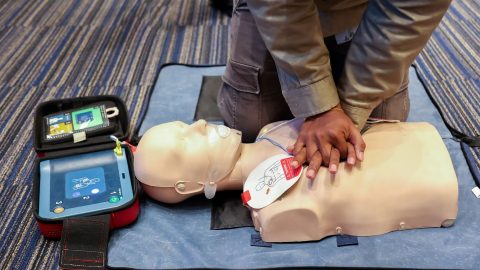
A typical CPR certification course combines instruction in chest compressions, rescue breathing, AED use, and choking response with a hands-on skills evaluation, and can be completed in a single session lasting a few hours. The exact format varies by provider and certification type, but the hands-on skills check is a constant across all legitimate courses.
What the Course Covers
- Recognizing the signs of cardiac arrest and when to act
- Performing high-quality chest compressions on an adult, child, and infant
- Delivering rescue breaths correctly
- Using an AED safely and effectively
- Responding to choking in adults, children, and infants
- (For BLS) Team-based resuscitation and use of a bag-valve mask
In-Person vs. Online vs. Blended Learning
- In-person courses include full instruction and a live skills check with an instructor.
- Blended learning courses let you complete the knowledge portion online at your own pace, then attend a shorter in-person session solely for the hands-on skills check.
- Fully online-only courses (with no in-person skills verification) are generally not considered complete certification by most employers, licensing boards, or hospitals, because there’s no way to confirm actual hands-on competence.
Important Note:
- If a course advertises itself as “100% online with instant certification” and never requires you to demonstrate compressions or AED use in front of an instructor, treat that as a red flag rather than a shortcut — see the legitimacy checklist later in this guide.
- If you choose a blended-learning course, you’ll need to complete the required in-person skills assessment within the provider’s specified timeframe before receiving your certification.
- The skills assessment isn’t just a formality—it’s how instructors verify that you can perform CPR correctly and safely in a real emergency.
The Hands-On Skills Test
This is the part that makes people nervous, and honestly, it shouldn’t. The skills check isn’t designed to catch you out — it’s designed to confirm you can do the basics under a little bit of realistic pressure.
Classroom observation: The most common mistake in the skills test isn’t compression depth or rate, it’s rescuers second-guessing themselves and pausing too long before starting. Instructors are looking for confident, continuous action far more than textbook-perfect form.
How Long Does the Class Take?
Course length varies by provider, certification type, and format, but general CPR/AED and BLS courses are commonly designed to be completed within a single session — often a few hours for lay-rescuer courses and somewhat longer for BLS. Blended-learning formats shorten the in-person portion since the coursework is completed beforehand online.
What Recent Guideline Updates Mean for Your Training
CPR and emergency cardiovascular care guidelines are reviewed and updated periodically by organizations like the American Heart Association, based on the latest resuscitation science. Because these updates directly affect technique — including things like choking response and the structure of the Chain of Survival — the training you receive should always reflect the current version of these guidelines, not whatever was standard years ago.
This is one of the most overlooked details in choosing a class. A class taught from outdated materials might teach a choking-response sequence or emergency framework that no longer matches current best practice. When researching a provider, it’s reasonable to simply ask: “Are your courses aligned with the current guidelines?” A legitimate, well-run training provider will answer that confidently and specifically.
Why this matters practically: Guideline updates aren’t cosmetic. They reflect new evidence about what actually improves survival outcomes — updated approaches to choking response and the way multiple emergency-response frameworks (adult, pediatric, in-hospital, out-of-hospital) have been unified into a single, simpler model are two recent examples. Training that lags behind current guidance can mean learning a technique that’s since been revised.
Key takeaway: Ask about guideline currency before you enroll — it’s a fair, simple question that tells you a lot about a provider’s quality.
What Does CPR Certification Cost?
CPR certification costs vary based on certification type, provider, course format, and location, and there is no single fixed nationwide price. Rather than quoting a number that may not apply to your situation, here’s what actually drives the cost so you can evaluate any course you’re considering.
What Affects the Price
- Certification type — lay-rescuer CPR/AED courses are typically less expensive than BLS, and BLS is typically less expensive than advanced courses like ACLS or PALS.
- Format — blended learning is sometimes priced lower than fully in-person courses because less instructor time is required.
- Add-ons — bundling CPR with First Aid certification, or purchasing a printed card versus a digital one, can affect total cost.
- Renewal vs. initial course — recertification courses are usually shorter and less expensive than a first-time certification course.
Practical tip: When comparing prices between providers, ask specifically what’s included — course materials, the certification card, and any retake policy if you don’t pass the skills check the first time. The cheapest listed price isn’t always the best value if it doesn’t include a legitimate hands-on component.
How Long Does CPR Certification Last? (Renewal & Recertification)
CPR certification is commonly valid for two years from the date of completion, after which recertification is required to keep the credential current. This two-year standard is widely used across major training organizations, though it’s always worth confirming the specific policy with your certifying provider or employer.
Why Skills Decline Before the Card Expires
Here’s something worth knowing even if your card isn’t expiring anytime soon: research on skill retention has found that CPR competence can begin declining within months of training, well before the two-year certification period ends. That’s not a flaw in the system — it’s simply how hands-on physical skills work, similar to any other trained motor skill that fades without practice.
Did you know? This is exactly why many training providers encourage periodic refreshers or practice sessions between formal recertification, even though it isn’t always required.
What Happens If Your Certification Lapses
Policies vary by provider, but generally:
- If you renew shortly after expiration, many providers offer a short grace period during which an abbreviated renewal course is still available.
- If your certification lapsed a while ago, you may be required to retake the full initial course rather than a shortened renewal.
Common mistake: Assuming your old certification is “close enough” to still count at work or for licensing purposes. Expired is expired — always check your certification date and your employer’s specific renewal deadline rather than assuming there’s flexibility.
Key takeaway: Set a reminder well before your two-year mark. A renewal course is typically shorter and less expensive than starting over — but only if you catch it before your card fully expires.
Common Myths vs. Facts About CPR Certification
Myth: You need to be young, strong, or athletic to perform CPR effectively.
Fact: Effective compressions rely on proper technique and body positioning, not raw strength — training is specifically designed to teach this to people of all fitness levels.
Myth: Once you’re certified, you’re certified for life.
Fact: Certification requires renewal, commonly every two years, because hands-on skills fade without practice or refreshers.
Myth: Any online CPR certificate is treated the same by every employer.
Fact: Employers and licensing boards vary widely in what they accept, and courses without a verified hands-on skills check are often not recognized as full certification at all.
Myth: Performing CPR incorrectly is worse than doing nothing.
Fact: Taking action — even imperfect action — during cardiac arrest is associated with far better outcomes than taking no action while waiting for help to arrive.
How to Choose a Legitimate CPR Certification Class
A legitimate CPR certification class always includes a verified in-person or hands-on skills check, is taught from currently accepted guidelines, and results in a recognized certification card — not just a printable certificate of attendance. Use the checklist below before enrolling in any course.
Legitimacy Checklist
- Course includes a hands-on skills check with a live instructor (not just an online quiz)
- Provider can confirm training reflects currently accepted guidelines
- Certification card or e-card is issued upon successful completion
- Instructor is certified to teach the specific course type
- You can confirm in advance that your employer or licensing board accepts this provider
- Retake or grace-period policy is clearly explained if you don’t pass on the first attempt
Professional tip: If you’re certifying for a specific job or license, it’s worth a two-minute phone call to your employer or licensing board to confirm the accepted provider before you pay for a course. It’s a small step that prevents a genuinely common and frustrating mistake.
CPR Certification for Specific Roles
Healthcare Workers & Nursing Students
If you’re entering nursing, EMS, or another clinical field, BLS certification — not general CPR/AED certification — is almost always the expectation. BLS builds in team-based resuscitation concepts and equipment use that align with hospital and clinical settings.
Teachers, Coaches & Childcare Providers
Certification requirements for these roles vary by school, district, and licensing authority, and sometimes by state. A CPR/AED certification that includes child and infant CPR is typically the relevant scope — confirm the specific requirement with your school, district, or licensing body rather than assuming.
Employers & Workplace Compliance
Many employers require CPR certification as part of workplace safety planning, sometimes influenced by general OSHA workplace-safety expectations. Since specific requirements can vary by industry and state, employers should verify their obligations directly rather than relying on general assumptions — and consider group or corporate training options to certify multiple employees efficiently.
Key Takeaways
- CPR certification requires a hands-on skills check — it’s never just an online quiz.
- The certification type you need depends on your role: general CPR/AED for most people, BLS for healthcare workers, and ACLS/PALS only for advanced clinicians.
- Provider acceptance (AHA, Red Cross, and others) varies by employer and licensing board — confirm before you enroll.
- Certification commonly lasts two years, but skills can decline well before that, so refreshers between renewals are worth considering.
- A legitimate class always includes current guideline-based instruction, a live skills check, and a recognized certification card.
Ready to Get Certified?
Understanding certification is the first step — the next one is finding the right class for your situation. Whether you’re certifying for a job, a license, or your own peace of mind, choosing a course that matches your role and includes a real hands-on skills check will save you time and guesswork later.
Browse CPR certification classes to find the certification type and format that fits your schedule, or compare certification options if you’re still deciding between CPR/AED and BLS. If your certification is close to expiring, you can also explore renewal courses designed to be faster than starting from scratch.
Frequently Asked Questions
What does it mean to be "CPR certified"?
Being CPR certified means you’ve completed an approved course covering chest compressions, rescue breathing, and AED use, and demonstrated those skills hands-on to an instructor. It’s a verified, renewable credential — not a one-time reading assignment.
Do I need to be certified to perform CPR in an emergency?
No — anyone can attempt CPR in a genuine emergency, and taking action is generally far better than doing nothing while waiting for help. Certification simply confirms and formalizes that you’ve been trained and tested on the proper technique.
How long does it take to get CPR certified?
Most lay-rescuer CPR/AED courses are designed to be completed in a single session, often a few hours, while BLS and blended-format courses may vary slightly in length depending on the provider.
Is CPR certification the same as First Aid certification?
No. CPR certification focuses specifically on cardiac and breathing emergencies, while First Aid certification covers a broader range of injuries and illnesses. Many providers offer them bundled together, but they are distinct credentials.
How long does CPR certification last?
CPR certification commonly lasts two years from the completion date before renewal is required, though it’s worth confirming the exact policy with your specific provider.
What's the difference between CPR certification and BLS certification?
They share the same foundational skills, but BLS certification is designed specifically for healthcare providers and includes team-based resuscitation concepts, while general CPR/AED certification is designed for the general public.
Is American Heart Association or American Red Cross certification better?
Neither is universally “better” — both are widely recognized training organizations. The right choice depends on what your employer, school, or licensing board specifically accepts, so it’s worth confirming before you enroll.
Can I get CPR certified fully online?
Generally, no — most recognized certifications require an in-person or live hands-on skills check in addition to any online coursework, because hands-on competence can’t be verified through a screen alone.
What happens if my CPR certification expires?
Policies vary by provider, but many offer a short grace period for an abbreviated renewal course shortly after expiration. If your certification lapsed further back, you may need to retake the full initial course.
Do I need to retake the full course if my certification lapses?
It depends on how long it’s been since expiration and your specific provider’s policy — always check directly rather than assuming a shortened renewal will still be available.
What is covered in a CPR certification class?
A typical class covers recognizing cardiac arrest, performing compressions and rescue breaths on adults, children, and infants, using an AED, and responding to choking emergencies.
Will I have to pass a hands-on skills test?
Yes — a hands-on skills check with a live instructor is a standard, required part of any legitimate CPR certification course.
How much does CPR certification typically cost?
Cost varies based on certification type, provider, course format, and any bundled add-ons like First Aid certification; there’s no single fixed nationwide price.
What is the difference between in-person, online, and blended CPR courses?
In-person courses include full live instruction and testing; blended courses let you complete coursework online before a shorter in-person skills check; fully online-only courses without a skills check are generally not accepted as complete certification.
Does OSHA require CPR certification for employees?
Workplace safety expectations can be influenced by general OSHA standards, but specific requirements vary by industry and state — employers should verify their exact obligations directly rather than assuming a blanket rule applies.
Will my employer accept any CPR certification, or does it need to be from a specific provider?
This varies by employer and industry. Some employers, especially hospitals, prefer a specific provider (commonly AHA for clinical BLS), while others are more flexible as long as the course includes a verified hands-on component. Always confirm directly with your employer.
What certification do healthcare workers need vs. general employees?
Healthcare workers typically need BLS certification, which includes clinical, team-based resuscitation elements, while general employees typically need standard CPR/AED (lay-rescuer) certification.