
Quick answer
- Do you need it? Often yes, but rules vary by state, district and job role.
- What to take: A CPR, AED and First Aid course that covers adults, children and infants, with hands-on skills practice.
- Before you pay: Ask your school or district in writing what they accept.
A student slumps over at a desk. A colleague stops mid-sentence in the staff room. A child coughs, then goes silent at lunch. Most teachers hope never to meet a moment like this. Most also know that, if it happens, they will be the adult in the room.
This guide covers what teachers need to know about CPR (cardiopulmonary resuscitation, the combination of chest compressions and, when trained, rescue breaths that keeps blood moving when the heart stops). You will find how requirements work, which course fits, what your school is likely to accept, and what to do in the first minutes of an emergency.
Next step: If you already know you need a class, you can compare CPR certification options or choose a class. If you are still working out what applies to you, keep reading.
Do Teachers Need to Be CPR Certified?
Sometimes. Whether a teacher must hold CPR certification depends on state law, district policy, the teacher’s license and the job itself. Some places require it for licensure or employment. Others require only that certain staff members be trained. Many schools simply expect it. Always confirm with your employer.
That answer can feel unsatisfying, so here is what sits behind it.
Why requirements vary
Four layers can apply to you at once:
- State law or regulation. Some states require trained staff in schools or training as part of licensure. Examples seen in provider summaries include Virginia and Kentucky, but these are secondhand and change over time, so check the state education department directly.
- District or school policy. A district can require more than the state does.
- Your role. Physical education teachers, coaches, early-childhood staff and special education teachers are often held to extra expectations.
- Your contract or hiring paperwork. Offer letters and onboarding checklists sometimes list CPR in a line that is easy to miss.
How to confirm your requirement in about 10 minutes
- Search your state department of education site for “CPR” together with “educator license” or “school staff.”
- Open your district’s policy pages or employee handbook and look under health, safety or professional development.
- Email your principal or HR contact with the three questions below.
- Save the reply. If your card is ever questioned, you will have it.
Three questions to ask HR
- Is CPR/AED/First Aid training required for my role, and for which age groups?
- Do you require a hands-on skills session, or is an online-only course accepted?
- Do you accept certain providers only, such as the American Heart Association (AHA) or the American Red Cross?
Instructor insight. The most common problem is not a missing card. It is a card from the wrong course. Teachers often finish a course built for healthcare workers, or an online-only course, and later learn that their district wanted something different. A short email beforehand prevents this.
Requirements by role at a glance
These are typical expectations, not legal requirements. Your school sets the rule.
| Role | What is commonly expected |
| Classroom teacher | Adult, child and infant CPR, AED and First Aid for many schools |
| Substitute teacher | Varies widely; some districts require it before assignment, others do not |
| PE or health teacher | Often held to a higher expectation because of physical activity |
| Coach | Frequently required by athletic associations or districts |
| Early childhood or preschool staff | Infant and child skills are especially emphasized |
| Administrator | Often responsible for ensuring enough trained staff are on site |
Myth vs. fact Myth: The school nurse handles every emergency. Fact: Many schools do not have a nurse in the building all day, and even where one is present, it may take minutes to reach the scene. Early CPR by whoever is closest improves the chance of survival.
What Type of CPR Certification Do Teachers Need?
Most teachers need a lay rescuer course: CPR, AED (automated external defibrillator) and First Aid, covering adults, children and infants. Healthcare providers take a different course, called Basic Life Support (BLS). If your employer does not specify BLS, a standard course is usually the right fit.
What “lay rescuer” means
A lay rescuer is someone who is not a healthcare professional. The course teaches you to recognize an emergency, call for help, perform compressions, use an AED and relieve choking. Because teachers work with children, age-specific skills matter as much as adult ones.
CPR/AED/First Aid vs. BLS
| Feature | CPR/AED/First Aid | BLS |
| Designed for | The general public, school staff, workplace responders | Healthcare professionals |
| Typical audience | Teachers, coaches, childcare workers | Nurses, EMTs, some school health staff |
| Focus | Recognizing emergencies, compressions, AED, choking, first aid | Team-based resuscitation, advanced airway tools, clinical roles |
| Usually right for a teacher? | Yes, in most cases | Only if your job or employer asks for it |
School nurses, athletic trainers and some health-room staff may fall under BLS. If that describes you, see our BLS certification course.
Why all three age groups matter
A high school teacher might think infant skills are irrelevant. A course that covers all ages still helps. Many state and district requirements name adults, children and infants. And a teacher may also be a parent, a coach, or a family member who babysits.
AHA, Red Cross and other providers
The American Heart Association and the American Red Cross are the two best-known training organizations in the United States. Their courses follow resuscitation science and may differ in structure, naming and card policies. Some employers name one organization. Others accept any nationally recognized program with hands-on skills. Neither is the answer for every school, so ask rather than assume.
Online, Blended or In-Person: What Will Your School Accept?
CPR training comes in three formats. Fully in-person classes teach and test skills in one session. Blended courses combine online lessons with a short hands-on skills check. Online-only courses have no in-person practice. Many schools require a hands-on component, so confirm acceptance before enrolling.
| Format | How it works | Hands-on practice | Time | Good fit when |
| In-person | All instruction and skills in one class | Yes | One session | You want an instructor and a manikin |
| Blended | Online lessons, then a short in-person skills check | Yes | Flexible online plus short session | You have a busy schedule |
| Online-only | Videos and quizzes only | No | Flexible | Your employer explicitly accepts it |
Read this table row by row: each row names a format, how it works, whether it includes hands-on practice, how long it takes and when it fits.
Why hands-on practice matters
Compressions are a physical skill. Adults are generally taught to push at least 2 inches (about 5 cm) and no more than about 2.4 inches (6 cm) at a pace of 100 to 120 per minute. Children and infants need about one-third the depth of the chest. You cannot judge depth or rhythm from a video. A manikin with feedback makes the difference clear in seconds.
Common mistake Buying an online-only card before confirming acceptance. If your district requires hands-on skills, you may need to pay again.
A script for asking your school
“I am planning to complete CPR, AED and First Aid training for adults, children and infants. Will you accept a blended course with an in-person skills session from [provider]? If you prefer a specific provider or format, please let me know before I enroll.”
Professional tip: Ask for the answer in writing, and keep the email with your certification record.
What You Will Learn in a Teacher CPR Course
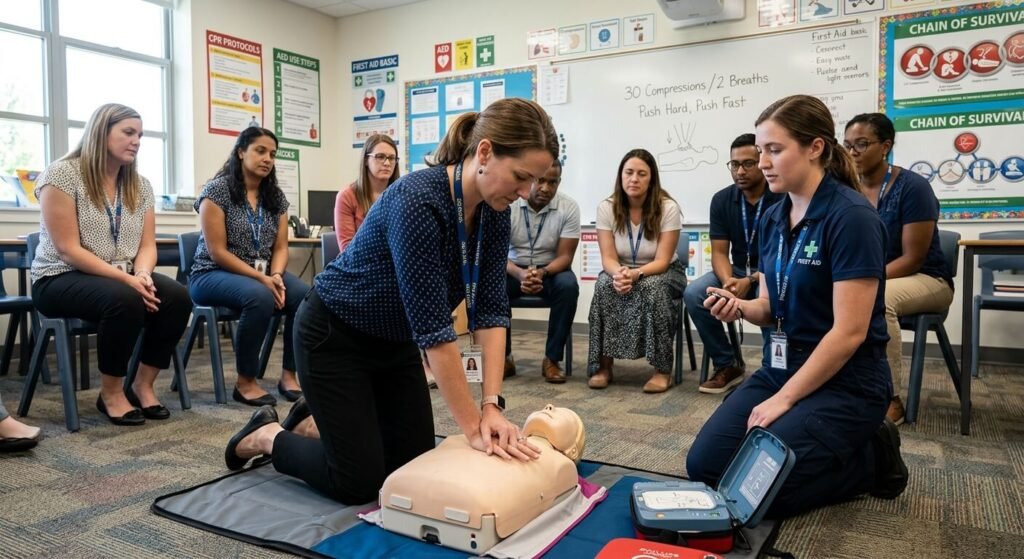
A typical teacher course covers recognizing cardiac arrest, calling 911, performing compressions, using an AED, relieving choking in adults, children and infants, and basic first aid. You practice on manikins and demonstrate skills to an instructor. Exact content varies by provider.
What most courses cover
- Recognizing when someone is unresponsive and not breathing normally
- Calling 911 and getting an AED
- Chest compressions for adults, children and infants
- Using an AED safely
- Choking relief for adults, children and infants
- Basic first aid, which may include bleeding, burns, allergic reactions and asthma
- Reducing exposure to blood and bodily fluids
What changed in the latest AHA guidelines
The American Heart Association updated its resuscitation guidelines in late 2025. According to reports on that update, key points for school staff include:
- Choking in a conscious adult or child: alternate five back blows with five abdominal thrusts until the object comes out or the person becomes unresponsive.
- Choking in an infant: five back blows alternating with five chest thrusts.
- One chain of survival: the separate adult, child, in-hospital and out-of-hospital chains were combined into one.
- Opioid overdose: a new public-access approach covers recognition, naloxone and rescue breaths.
- Young people: evidence supports teaching CPR and AED use to children aged 12 and older.
Training organizations adopt updates on their own schedule, so your course materials set the exact steps you will be taught. If your certification is older, ask about any updated content.
Did you know? Teaching children aged 12 and older is now supported by evidence. This makes middle and high school CPR education a natural partner for staff training.
What to Do If a Student or Colleague Collapses at School
If someone collapses and is not responding or not breathing normally, call 911, send someone for the AED, and start chest compressions right away. Use the AED as soon as it arrives and follow its voice prompts until emergency medical services (EMS) take over. Do not stop unless told to.
This is the section most competitors skip. A course teaches the skills. The classroom adds complications: other students, an office phone, a distant AED. Plan for those.
The first five minutes: who does what
Even alone, you can set events in motion quickly. With help nearby, assign tasks by name or pointing.
- Check. Tap and shout. Look for normal breathing for no more than 10 seconds.
- Call. Tell a specific person: “You, call 911 and say we need an ambulance.” If alone, use speakerphone.
- Fetch. Send another person: “You, bring the AED.”
- Compress. Begin hard, fast compressions in the center of the chest. Let the chest fully rise between pushes.
- Use the AED. Turn it on, attach the pads, and follow the prompts. Resume compressions when told.
- Manage the room. If another adult is available, they move students away and keep them calm.
- Meet EMS. Someone waits at the entrance, keeps doors open and guides responders in.
Realistic scenario (illustrative). A teacher in a science classroom sees a student fall from a stool and not respond. The teacher yells into the hallway for help, points at a student by name to run to the office, and starts compressions. The office staff call 911 and bring the AED. By the time EMS arrives, the AED has been attached and compressions are ongoing. The key moves were clear instructions, immediate compressions and a pre-agreed location for the AED.
Professional tip: Know where the nearest AED is before you need it. Check the location on your first day and again after any room change.
Choking in the classroom or cafeteria
If a child or adult can cough or speak, encourage them to keep coughing. If they cannot breathe, cough, or speak, call for help and follow your course’s choking sequence. Under the latest AHA guidance for a conscious adult or child, that means alternating five back blows with five abdominal thrusts until the object clears or the person becomes unresponsive. If they become unresponsive, call 911 if not already done and begin CPR.
For infants, the sequence is five back blows alternating with five chest thrusts. Do not use abdominal thrusts on an infant.
Important note Some courses and organizations may teach slightly different choking steps, especially if your certificate predates the latest guidelines. Follow the instructions of your most recent training.
Using a school AED
An AED analyzes the heart’s rhythm and delivers a shock only if one is needed. It speaks clear instructions. Lay rescuers can use one safely. For children, many AEDs come with smaller pads or a child setting. If child pads are not available, current guidance supports using adult pads rather than waiting. Do not delay use.
Common mistake. Hesitating because the person is a child, or because the AED “might hurt them.” The AED will not shock a heart that does not need it.
Suspected opioid overdose
Signs can include unresponsiveness, very slow or absent breathing and blue or gray lips. Call 911 and follow your school’s policy on naloxone, which may be stocked in some schools. If the person is not breathing normally, current guidance includes rescue breaths and CPR along with naloxone. Follow the dispatcher’s instructions and your school’s protocol.
When it is not cardiac arrest
Not every emergency needs CPR. A seizure, a severe allergic reaction or an asthma attack each call for different first steps. Student health plans, such as seizure or allergy action plans, tell you what to do. When in doubt, call 911 and follow the dispatcher.
After the emergency
- Hand over to EMS and tell them what you saw and did.
- Notify administrators and follow your district’s incident process.
- Write down the timeline while it is fresh.
- Take care of yourself. Debriefing with a colleague, school counselor or employee assistance program can help.
Reassurance You do not need to be perfect. In cardiac arrest, a person who receives no CPR has fewer chances. Doing something is better than doing nothing, and the 911 dispatcher can coach you.
Legal Protection for Teachers Who Give CPR
Most U.S. states have Good Samaritan laws that offer legal protection to people who give emergency aid in good faith. Details vary by state, and school employees may also be covered by district or state rules. This is general information, not legal advice. Ask your district or a qualified attorney about your situation.
Myth vs. fact Myth: A teacher can be sued for any attempt to help. Fact: Protections exist in many places for good-faith emergency care, though specifics differ. Not acting can also carry consequences for staff with a duty to respond. Ask HR how your district handles this.
How Much Does Teacher CPR Training Cost, and Who Pays?
Prices depend on the provider, course type and location. Some employers pay for staff training, host on-site classes or reimburse the cost. Ask your school before paying out of pocket, and compare formats rather than only price. A cheaper course your school rejects costs more in the end.
Quick tip. If several colleagues need certification, ask about group or on-site training. Many schools schedule it on a staff development day. See group CPR training for school staff.
How Long Does Certification Last, and How Do You Renew?
CPR certification cards are commonly valid for two years, though policies differ by organization and course. Check the expiration date on your card. Renewal usually involves a shorter refresher course and a skills check. Do not wait until the last week, because classes can fill.
Timeline: Hired or onboarded, then initial course, then card issued, then calendar reminder about three months before expiration, then renewal course, then new card.
Practical tip. Put the expiration date in your phone calendar and ask HR to record it too. If you let it lapse, you may have to take the full course again. See our CPR renewal options.
Beyond the Classroom: Coaches, PE, Special Education and Early Childhood
Staff who supervise physical activity, very young children or students with complex health needs often face higher expectations. Their training should match the setting: infant skills for early childhood, AED readiness for athletics, and familiarity with individual health plans for special education.
- Coaches and PE teachers: Sudden cardiac arrest can happen during exercise. Know where the AED is and how fast you can reach it from the field or gym.
- Early childhood staff: Choking is a leading concern with young children. Practice the infant and child sequences often.
- Special education staff: Learn each student’s emergency health plan. It can change the first step, such as for seizures or feeding tubes.
- Substitutes: Ask the front office on arrival where the AED, first-aid kit and emergency procedures are.
Classroom observation. Instructors often hear that teachers feel most worried about students with medical conditions. A five-minute conversation with the school nurse or student health coordinator, before the year gets busy, takes much of that worry away.
Physical education, health and sports staff may also be interested in teaching CPR to students. Our CPR instructor courses are one path for that.
For Administrators: Building a School CPR Readiness Plan
A school CPR readiness plan makes sure trained people, working AEDs and clear procedures are available during every part of the school day. It should cover who is trained, where equipment sits, how staff call for help and how often the school practices.
Administrator checklist
- List which staff hold current certification and when each card expires
- Make sure trained staff cover lunch, recess, after-school activities and athletics
- Place AEDs where they can be reached quickly and check them on a schedule
- Post emergency steps and the AED location in each classroom
- Run short drills so staff can practice roles
- Decide how substitutes and new hires get oriented
- Schedule group or on-site training before the school year starts
Employer perspective. Schools that plan training as a group often find it easier to track expirations and to practice emergency roles together. See our group CPR training for schools, or contact an instructor to talk through your needs.
Common Mistakes Teachers Make with CPR Training and Response
The most common errors are choosing a course the school will not accept, letting a card expire, hesitating to start compressions, pressing too lightly or slowly, and not knowing where the AED is. Most can be fixed with a short plan and a little practice.
- Buying before asking. Confirm acceptance first.
- Taking the wrong course. Teachers rarely need BLS unless asked.
- Waiting too long to start. If the person is unresponsive and not breathing normally, start compressions.
- Compressing too shallow or too slow. Push hard and fast, and let the chest fully rise.
- Stopping early. Continue until EMS takes over, the person responds or an AED tells you otherwise.
- Skipping the AED. Send someone for it right away.
- Ignoring updates. Ask whether your course reflects current guidance, especially for choking.
- Forgetting renewal. Set a reminder.
How to Choose a Provider and Take the Next Step
Choose a provider whose courses match your employer’s requirements, include hands-on practice, are taught by qualified instructors and offer schedules you can manage. Confirm acceptance first, then book. If you cannot find an answer, ask the provider whether their cards have been accepted by schools similar to yours.
Checklist before you enroll
- You have your school’s requirement in writing
- The course covers adults, children and infants, plus AED and First Aid
- It includes a hands-on skills session
- The instructor’s credentials and the provider’s accreditation are listed
- You know the card’s validity and renewal process
If that all checks out, you can register for a CPR, AED and First Aid class or compare certification options. If you need to renew, see CPR renewal.
Frequently Asked Questions
Beginner questions
Do teachers have to be CPR certified? It depends on state law, district policy and your job. Many schools require it or strongly expect it. Confirm with your employer, and ask for the answer in writing.
What CPR certification do teachers need? Most teachers need a CPR, AED and First Aid course covering adults, children and infants, with hands-on practice. BLS is generally for healthcare providers unless your employer asks for it.
Is CPR training the same as first aid training? No. CPR focuses on cardiac arrest and choking. First aid covers a wider range of injuries and illnesses, such as bleeding, burns and allergic reactions. Many teacher courses combine them.
Can a teacher be sued for performing CPR? Good Samaritan laws in many states protect people who give emergency care in good faith. Details vary, so ask your district about how it applies to school employees. This is not legal advice.
Certification questions
How long is teacher CPR certification valid? Cards are commonly valid for two years, but policies vary by organization and course. Check the expiration date on your card.
Is online CPR certification accepted for teachers? Sometimes, but many schools and districts require hands-on skills practice. Ask your employer before enrolling. A blended course, with online lessons and an in-person skills session, is a common compromise.
Do teachers need BLS or standard CPR? Standard CPR/AED/First Aid is usually right for teachers. BLS is designed for healthcare professionals, so it fits school nurses and athletic trainers more than classroom staff.
How do I renew my CPR certification as a teacher? Take a renewal or refresher course before your card expires, and complete the skills check. Policies differ by provider, so confirm the process and any grace period.
Do substitute teachers need CPR certification? It varies by district. Some require it before assignment, and others do not. Ask the district or staffing office.
Practical questions
What should a teacher do if a student collapses? Check for response and normal breathing, call 911, send someone for the AED, and start chest compressions. Use the AED when it arrives and continue until EMS takes over.
How do you help a choking student? If the student cannot breathe, cough or speak, call for help. For a conscious child or adult, alternate five back blows with five abdominal thrusts until the object clears or the person becomes unresponsive. If they become unresponsive, begin CPR. Follow your course’s most recent instructions.
Can teachers use an AED on a child? Yes. AEDs are designed for use by trained and untrained rescuers. If child pads or a child setting are available, use them. If not, guidance supports using adult pads rather than delaying.
What should teachers do about a suspected opioid overdose? Call 911, follow your school’s policy on naloxone, and begin rescue breathing or CPR if the person is not breathing normally. Follow the dispatcher’s guidance.
Workplace questions
Does my school have to pay for my CPR training? That depends on your employer and state rules. Many schools pay or reimburse, some host on-site classes. Ask HR before paying yourself.
Can a school schedule CPR training for all staff? Yes. Many providers offer group or on-site sessions that can be scheduled around a staff development day.
Local questions
What are the teacher CPR requirements in my state? Check your state department of education and your district. Provider summaries can be a starting point, but the state source is the final word. See our state-by-state guide.
Where can I take a CPR class for teachers near me? Look for providers offering hands-on skills sessions in your area, and confirm acceptance with your school. You can view upcoming classes with us.
Still have a question about what your school will accept? Contact an instructor and we will help you work it out before you enroll.
Key Takeaways
- Teacher CPR requirements vary by state, district and role, so confirm yours in writing.
- Most teachers need CPR, AED and First Aid for adults, children and infants. BLS is for healthcare roles.
- Hands-on practice matters, and many schools require it.
- In an emergency: check, call 911, send for the AED, start compressions, assign roles and meet EMS.
- Choking guidance changed in the latest AHA update, so follow your most recent training.
- Certification is commonly valid for two years. Set a renewal reminder.
- Schools benefit from planning training as a group.
Ready for the Next Step?
Knowing what to do is one thing. Practicing it with an instructor beside you is another, and it is how people feel steady when a real emergency arrives. When you are ready, register for a CPR, AED and First Aid class, explore group training for your school, or renew your certification.
Educational information only. This article does not replace hands-on training, medical advice or legal advice. Follow your school’s policies and local emergency instructions.