
What Is CPR Certification?
CPR certification is proof that you’ve completed a training course covering cardiopulmonary resuscitation and, in most cases, the use of an automated external defibrillator (AED). It typically involves both instruction and a hands-on skills check, and it results in a certification card that’s valid for a set period before renewal is required.
Most people don’t wake up curious about CPR certification out of nowhere. Something prompts it — a new job that requires it, a coaching role, a childcare license, or simply the realization that you’d rather know what to do than freeze up if someone collapsed in front of you. Whatever brought you here, the good news is that the process is more approachable than it sounds, and this guide will walk you through exactly what it involves.
Quick Takeaway: CPR certification means you’ve been trained and tested on recognized resuscitation skills by an accredited provider, and you carry a card (physical or digital) as proof.
One thing worth clearing up immediately: “CPR certification” is often used as a catch-all term, but it actually covers several distinct course types — and knowing which one applies to you will save you time, money, and a fair amount of confusion. We’ll walk through that next.
Why CPR Certification Matters
CPR certification matters because bystander action in the first few minutes of a cardiac emergency directly influences outcomes, and untrained bystanders are far less likely to intervene confidently. Certification closes that gap by teaching people what to do, when to do it, and how to do it correctly under pressure.
Think of it as a chain, where each link depends on the one before it:
Cardiac Arrest → CPR → AED → EMS Arrival → Hospital Care → Recovery
This is often called the chain of survival, and it’s a useful mental model even outside of a classroom. When someone’s heart stops beating effectively, they need immediate compressions to keep blood moving to the brain and vital organs. An AED, if available, can help restore a normal heart rhythm. Emergency medical services then take over and transport the person to a hospital, where recovery care continues.
Every link in that chain matters, but the first one — the bystander who starts CPR before professional help arrives — is the one certification training is designed to prepare you for. You’re not expected to replace EMS. You’re expected to buy time.
Instructor Insight: “The students who struggle most aren’t the ones who are bad at compressions — they’re the ones who freeze because they’re afraid of getting it wrong. Certification training is as much about building the confidence to act as it is about the mechanics.”
Types of CPR & Related Certifications
There isn’t just one “CPR certification.” The right course depends on your role, your workplace, and whether you’re a general bystander or a healthcare provider — and mixing these up is one of the most common (and costly) mistakes people make when signing up for training.
CPR/AED Certification (Lay Rescuer)
This is the course most people mean when they say “CPR certification.” It’s designed for the general public — parents, teachers, coaches, fitness professionals, and employees — and covers adult, child, and often infant CPR, AED use, and basic choking response. No medical background is required.
Basic Life Support (BLS) Certification
BLS is designed for healthcare providers: nurses, EMTs, medical assistants, nursing students, and other clinical staff. It covers CPR and AED use in more depth, often including team-based resuscitation scenarios, multiple-rescuer techniques, and use in a clinical setting. If your job involves direct patient care, your employer almost certainly requires BLS, not general CPR/AED certification.
First Aid Certification
First Aid certification covers a broader range of non-cardiac emergencies — cuts, burns, sprains, allergic reactions, and other injuries. It’s frequently bundled with CPR/AED certification into a combined course, since many employers and licensing bodies require both.
ACLS and PALS (Advanced Certifications)
Advanced Cardiovascular Life Support (ACLS) and Pediatric Advanced Life Support (PALS) are advanced-level certifications for healthcare providers who manage cardiac and pediatric emergencies as part of their clinical role, such as physicians, nurses, and paramedics. These build on BLS and involve medication protocols and advanced airway management — they’re not a starting point for most learners.
Comparison at a Glance
| Certification | Who It’s For | Typical Setting Covered |
| CPR/AED (Lay Rescuer) | General public, employees, coaches, parents | Everyday/community settings |
| BLS | Healthcare providers, nursing/medical students | Clinical and team-based settings |
| First Aid | General public, workplaces | Non-cardiac injuries and emergencies |
| ACLS / PALS | Physicians, nurses, paramedics | Advanced cardiac/pediatric emergencies |
Which Certification Do I Need? (Decision Guide)
If you’re still not sure, work through this quickly:
- Are you in a clinical/healthcare role (nursing, EMS, medical assisting)? → You likely need BLS, not general CPR certification. Check with your employer or program to confirm.
- Does your job or license require both injury response and cardiac response (e.g., childcare, coaching, fitness instruction)? → Look for a combined CPR/AED and First Aid course.
- Are you a parent, caregiver, or simply want to be prepared? → A standard CPR/AED certification course covers what you need.
- Do you already manage advanced cardiac or pediatric emergencies as part of your clinical scope of practice? → You may need ACLS or PALS, typically after BLS.
Myth vs. Fact
Myth: “CPR certification and BLS certification are basically the same thing.” Fact: They overlap in core skills, but BLS is built for clinical, team-based response and is typically required for healthcare roles — a general CPR/AED card usually isn’t an accepted substitute.
What Happens in a CPR Certification Class
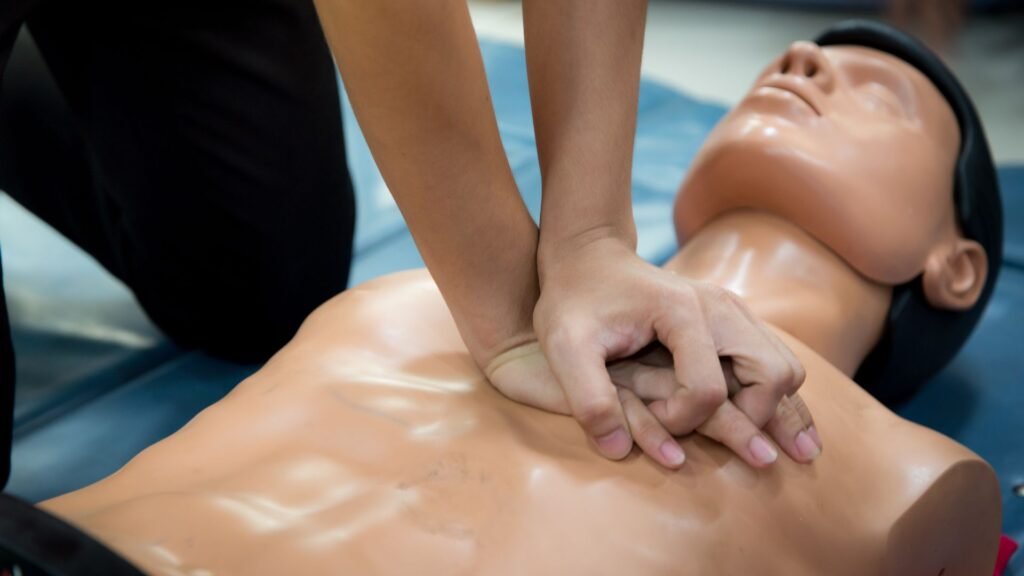
A CPR certification class typically combines instructional content — delivered in person, online, or through a blended format — with a hands-on skills check where you demonstrate compressions, rescue breaths, and AED use on a training manikin. Most courses take a few hours to complete.
Here’s roughly what to expect, regardless of provider:
- Instruction: Video, in-person teaching, or online modules covering recognition of an emergency, when and how to call for help, compression technique, rescue breathing, AED use, and choking response.
- Hands-on practice: Time with a training manikin to build muscle memory for compression depth, rate, and hand placement.
- Skills check: An instructor observes you performing the skills correctly. This isn’t about perfection on the first try — it’s about demonstrating the core technique safely.
- Certification card: Issued upon successful completion, either as a physical card, a digital card, or both, depending on the provider.
Common Mistake: Many first-time students assume they need to memorize exact compression counts under time pressure. In reality, most courses teach you to work at a steady, practiced pace rather than counting perfectly — the goal is competence, not a stopwatch performance.
What Students Often Ask: “What if I mess up during the skills check?” Instructors expect this. The skills check is a teaching moment, not a pass/fail trap — most instructors will coach you through corrections in real time rather than simply failing you.
Is Online CPR Certification Legitimate?
Online CPR certification can be legitimate, but legitimacy depends on the provider’s accreditation and whether the course includes a genuine hands-on skills assessment where required. Purely self-paced, no-skills-check courses are accepted by some employers for general awareness but are often rejected by healthcare employers and licensing bodies that require an in-person or live-virtual skills check.
Before enrolling in an online course, verify three things:
- Accreditation — Is the course backed by a recognized organization, and does it clearly state its accreditation?
- Skills verification — Does the course include an in-person or live-virtual skills check, or is it purely video-and-quiz based?
- Employer/licensing acceptance — Will the specific body requiring your certification actually accept this format? This varies enough that it’s worth confirming directly rather than assuming.
Professional Tip: If your certification is for a job, license, or clinical role, call or email whoever is requiring it and ask directly: “Does this need to include an in-person skills check?” It takes five minutes and can save you from redoing a course.
How Much Does CPR Certification Cost
CPR certification cost varies based on the provider, course type, and format (in-person versus online or blended), and it’s also common for cost to depend on whether First Aid or AED training is bundled in. Rather than a single fixed price, expect a range that reflects these factors, with combined courses and in-person skills sessions generally costing more than certification-awareness-only online options.
Factors that typically affect price:
- Course type — Standard CPR/AED vs. BLS vs. combined CPR/First Aid
- Format — Fully in-person courses often cost more than blended/online-plus-skills-check options
- Group vs. individual enrollment — Employers training multiple staff at once often receive different pricing than individual learners
- Provider — Costs differ between training organizations and instructors
Practical Example: An employee needing a basic CPR/AED card for a general workplace requirement will typically pay less than a nursing student who needs BLS with an in-person skills check bundled with First Aid.
How Long Does CPR Certification Take
Most CPR certification courses can be completed in a single session, typically lasting a few hours depending on the format and whether First Aid content is included. Blended courses — where instructional content is completed online beforehand — usually shorten the in-person portion to just the skills check, making the overall time commitment more flexible.
If your schedule is tight, ask providers specifically about blended formats: you complete the coursework independently, then attend a shorter in-person session focused only on demonstrating the physical skills.
How Long Is CPR Certification Valid?
CPR certification is typically valid for about two years from the date of completion, though the exact renewal period can vary by provider and certification type. After that window, recertification is required to keep your card current, and many employers track this closely since an expired certification can affect job eligibility.
Key Takeaway: Don’t wait until your card expires to think about renewal. Most providers offer a renewal course that’s shorter than the original certification, but only within a certain window after expiration — after that, you may need to retake the full course.
Common Mistake: Assuming an expired certification is “close enough.” If your employer, licensing board, or program requires current certification, an expired card is treated the same as no certification at all.
Who Requires CPR Certification
CPR certification requirements come from three main sources: employers (as a condition of employment or workplace safety compliance), licensing or regulatory bodies (such as childcare licensing agencies or professional boards), and personal or family motivations for those who simply want to be prepared. Each source may specify a different certification type, so it’s worth confirming exactly what’s required rather than assuming.
Employers
Many workplaces require CPR certification for safety compliance, particularly in roles involving physical activity, direct public interaction, or vulnerable populations (children, older adults, patients). Some employers accept general CPR/AED certification; others — particularly healthcare employers — require BLS specifically.
Employer Perspective: “We don’t just check the box that says ‘certified.’ We check whether it’s the right certification for the role, and whether it’s still current. A lapsed card creates real liability for us, not just the employee.”
Licensing Boards and Childcare Regulators
Certain licenses and regulatory approvals — such as childcare licensing, coaching certifications, or healthcare professional licensure — often specify CPR certification as a requirement, sometimes with specific provider or course-type requirements attached. Because these requirements can vary by role and by location, always verify directly with the licensing body rather than assuming any CPR card will satisfy the requirement.
Personal and Family Reasons
Not everyone certifies because they have to. Parents, grandparents, and caregivers often pursue certification simply to feel prepared for a medical emergency involving a loved one — and this motivation is just as valid as any workplace requirement.
How to Get CPR Certified (Step-by-Step)
- Determine which certification you need — Use the decision guide above to confirm whether you need CPR/AED, BLS, First Aid, or a combined course.
- Confirm requirements with whoever needs the certification — Employer, licensing board, or program, especially regarding accepted formats and providers.
- Choose a course format — In-person, blended, or online-with-skills-check, based on your schedule and requirement.
- Complete the coursework — Instructional content covering recognition, response, and technique.
- Complete the hands-on skills check — Demonstrate compressions, rescue breathing, and AED use to an instructor.
- Receive your certification card — Physical, digital, or both, depending on the provider.
- Track your renewal date — Mark your calendar so you’re not caught off guard when it’s time to recertify.
Quick Tip: Save a digital copy of your certification card as soon as you receive it, even if you also get a physical one. Employers frequently ask for a digital copy, and having it ready saves you a scramble later.
Common Myths About CPR Certification
Myth: “Once I’m certified, I’m certified for life.” Fact: Certification expires — typically around every two years, depending on the provider — and requires renewal to stay current.
Myth: “Any CPR certification will satisfy my employer’s requirement.” Fact: Some employers, especially in healthcare, require a specific certification type (like BLS) or a specific accreditation — always confirm before enrolling.
Myth: “I’ll be tested on perfect technique and can easily fail.” Fact: Skills checks are designed to be instructive, not punitive. Instructors typically coach you through corrections rather than failing you outright.
Myth: “Online certification is never legitimate.” Fact: It depends entirely on accreditation and whether a proper skills check is included — some online-plus-skills-check formats are widely accepted, while others aren’t.
Frequently Asked Questions
What is CPR certification? CPR certification is documented proof that you’ve completed a training course covering cardiopulmonary resuscitation, typically including AED use, and passed a hands-on skills check demonstrating those techniques.
Do I need to be CPR certified for my job? It depends on your role and employer. Jobs involving direct care, physical safety responsibility, or public interaction commonly require it — check with your employer to confirm whether it’s required and which type.
What’s the difference between CPR and First Aid certification? CPR certification focuses on cardiac emergencies and AED use, while First Aid certification covers a broader range of injuries and non-cardiac emergencies. Many providers offer them as a combined course.
How long does it take to get CPR certified? Most courses can be completed in a single session lasting a few hours, though blended formats that move instructional content online can shorten the in-person time required.
What’s the difference between CPR certification and BLS certification? CPR/AED certification is designed for the general public, while BLS is built for healthcare providers and includes more advanced, team-based resuscitation skills used in clinical settings.
Is online CPR certification legitimate? It can be, depending on the provider’s accreditation and whether the course includes a genuine hands-on skills check — verify both before enrolling, especially for job or licensing requirements.
Do I have to do an in-person skills check? Many certifications require one, particularly for healthcare roles. Some general-public courses accept a live-virtual skills check instead — confirm with your provider and whoever requires your certification.
What organizations offer CPR certification? The American Heart Association and the American Red Cross are the two most widely recognized providers in the United States, though other accredited organizations also exist.
How long is CPR certification valid? Most certifications are valid for approximately two years, though the exact period can vary by provider and certification type.
What happens if my CPR certification expires? An expired certification is generally treated the same as having no certification. Many providers offer a renewal course within a certain window after expiration; after that window, a full recertification course may be required.
How much does CPR certification cost? Cost varies by provider, course type, and format, with combined courses and in-person skills sessions typically costing more than certification-awareness-only online options.
What should I bring to a CPR certification class? Typically just comfortable clothing you can move in and any pre-course materials your provider requests, such as proof of completed online modules for a blended course.
Will I fail if I can’t complete compressions correctly on the first try? Unlikely. Instructors generally coach students through corrections during the skills check rather than failing them for an early mistake.
Can I renew CPR certification online only? Some providers offer online renewal, but many still require a skills check, especially for healthcare-related certifications — confirm with your specific provider and employer.
Does OSHA require CPR certification? OSHA doesn’t issue CPR certifications, but some workplace safety provisions can create a practical need for trained staff. Requirements vary by industry and role, so check current OSHA guidance and your employer’s policy directly.
Will my employer accept an online CPR certification? It depends on the employer and the course’s accreditation and skills-check format. Confirm directly with your employer before enrolling.
Do teachers, coaches, or childcare providers need a specific certification type? Often yes — many of these roles have specific licensing requirements tied to CPR and First Aid certification. Check with your school, licensing agency, or governing organization for exact requirements.
Key Takeaways
- CPR certification confirms you’ve completed accredited training and a hands-on skills check in resuscitation and AED use.
- CPR/AED, BLS, First Aid, and advanced certifications like ACLS/PALS are different courses for different roles — confirm which one you actually need before enrolling.
- Certification typically lasts around two years and requires renewal to stay current.
- Cost and time commitment vary by course type and format, with blended options offering more flexibility.
- Always verify specific requirements with your employer or licensing body rather than assuming any certification will be accepted.
Conclusion
Now that you know what CPR certification involves and which type fits your situation, the next step is choosing a course that matches your schedule and requirements. Compare CPR, BLS, and First Aid certification options to find the right fit and see upcoming class availability.